




Santa's Arctic Abode
Welcome to Rovaniemi, Finland, a city that holds the esteemed title of Santa Claus's official residence. This unique destination, renowned as the largest
city in Europe by sheer land area, is home to a population of approximately 63,000 individuals. Here, you can personally meet the legendary figure of Christmas, capture a memorable photograph, and even inquire about his secrets to enduring health and his philosophy on longevity. Though the peak holiday season has passed, Santa is far from idle; his elves are diligently at work in the world's northernmost post office. This postal hub receives an astonishing half a million letters annually from hopeful children and adults across the globe. The elves, along with Santa himself, dedicate the entire year to crafting responses to this immense volume of mail, ensuring every correspondent feels acknowledged and cherished. The Santa Claus Village itself is a magical place, straddling the Arctic Circle. Visitors have the exciting opportunity to officially cross this significant geographical line, with a live 'Santa Cam' broadcasting the experience. It's a place where both children and adults alike find themselves overcome with childlike wonder, often engaging in playful antics that rival the excitement of the younger ones.
A City Reborn
Rovaniemi, though now a vibrant hub of festive cheer and a gateway to the Arctic, carries a poignant history shaped by conflict. In the 1930s, it was a tranquil trading post. However, the tumultuous events of World War II drastically altered its trajectory. Following a period of conflict with Russia in 1939-40 and subsequent alliance with Germany, Rovaniemi became a German military base. As the war shifted, Finland was compelled by Russia to expel the Germans. In October 1944, the retreating German forces systematically razed the city, leaving it in ruins. The evacuation efforts resulted in significant loss of life, with 279 individuals perishing during their transit and another 200 losing their lives on their return journey to the devastated city. In the aftermath, the renowned Finnish architect Alvar Aalto was commissioned in 1945 to envision a new Arctic city. He ingeniously transformed the destruction into an opportunity, conceiving a master plan that incorporated the silhouette of a reindeer's head, harmoniously aligning with the natural landscape. The city's layout cleverly utilizes the confluence of the Kemijoki and Ounasjoki rivers, with the football stadium representing the reindeer's eye. This visionary design gave birth to the modern Rovaniemi, a city that pays homage to the region's iconic inhabitant.
An American Connection
A pivotal moment in Rovaniemi's post-war revitalization and global recognition came with a visit from Eleanor Roosevelt in June 1950. Eager to experience the Arctic Circle, Finland swiftly constructed a charming log cabin just a short distance from the airport. Legend has it that the builders discreetly departed through a back entrance as Mrs. Roosevelt entered the cabin, allowing her a private moment of discovery. She was informed that the cabin was situated on the Arctic Circle, though the actual precise line lay a few meters further north. It was from this very cabin that Eleanor Roosevelt penned a letter to then-US President Harry S. Truman, marking it as the first-ever letter to be officially posted from the Arctic Circle. This event significantly boosted the international allure of the Santa Claus Post Office, transforming it into a global attraction. Today, the walls of Santa's cabin are adorned with photographs of esteemed dignitaries who have visited over the years, including former Indian President Pranab Mukherjee, who presented Santa with a statue of Lord Ganesha in 2014, and Chinese Premier Xi Jinping, underscoring Rovaniemi's enduring appeal to world leaders.
Northern Lights Spectacle
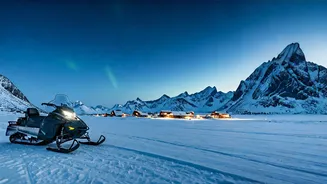
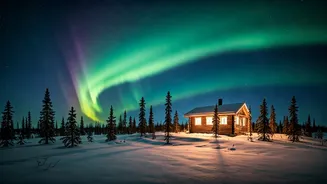
Rovaniemi is blessed with approximately 150 nights annually where the spectacular Aurora Borealis, or Northern Lights, grace the sky. These celestial displays are particularly vibrant during periods of increased solar activity. The mesmerizing dance of the lights can typically be observed from late August through early April, with the prime viewing hours between 10 PM and 2 AM. However, with a stroke of luck, one might witness this phenomenon even earlier. On a recent arrival, the intensity and brilliance of the aurora were so profound that the travel party had to make an unplanned detour simply to stand in awe and witness the breathtaking spectacle. Venturing a short distance from the city center, away from any significant light pollution, offers even clearer views. Rovaniemi's low population density and extensive undeveloped areas make it an ideal haven for aurora enthusiasts. Yet, a growing concern among locals, like Kertta from the Arktikum museum, is the diminishing duration of winter and thinning snow cover due to climate change. Snow plays an integral role in the Lappish way of life, with numerous distinct terms describing its various forms, and it's a cornerstone of the region's tourism. The Arktikum museum itself serves as a testament to the impacts of climate change in the Arctic.
Decoding the Aurora
The Arktikum museum in Rovaniemi is an architectural marvel, architecturally designed to point directly north towards the North Pole, which lies approximately 2,600 kilometers away. Its stunning glass-ceilinged corridor often serves as a picturesque backdrop for events and provides visitors with insights into the phenomenon of the Northern Lights. The Finnish name for the aurora, 'Revontuli Ovaali', is rooted in local folklore, relating to the myth of a fox running across the snow and its tail creating sparks, which were believed to be the Northern Lights. Scientifically, however, the aurora is a far more dynamic event. It occurs when charged particles emitted by the sun collide with the gases in Earth's upper atmosphere. Guided by the planet's magnetic field, these energetic particles are channeled towards the poles. Here, they interact with oxygen and nitrogen atoms, producing the ethereal glow that captivates observers. In Rovaniemi, the interplay of these atmospheric elements creates an experience so compelling that many find themselves perpetually looking upwards, mesmerized by the celestial ballet above.