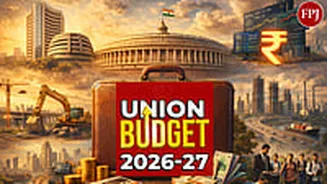








Budget's Financial Overview
The Union Budget 2026-27 featured several significant financial allocations. The Ministry of Home Affairs received a substantial allocation of Rs 2.5 lakh
crore, underscoring the government's focus on internal security and governance. The Ministry of External Affairs was allocated Rs 22,118 crore, reflecting India's growing role on the global stage. Furthermore, the budget proposed a record capital expenditure (Capex) of Rs 12.22 lakh crore for the fiscal year 2027, demonstrating a commitment to infrastructure development and long-term economic growth. The Railways sector saw a considerable capital expenditure allocation of Rs 2.77 lakh crore, which would likely drive improvements in transportation infrastructure and logistics. In Jammu & Kashmir, a proposed transfer of Rs 43,290 crore by the Centre aimed to boost regional development initiatives. Finally, Rs 6,000 crore was set aside for the Census 2027, an essential undertaking for planning and policy formulation.
Sectoral Allocations & Impact
Several sectors witnessed focused budgetary support. The power sector's Public Sector Units (PSUs) were slated for a 19% increase in investment for Fiscal Year 2027, aimed at enhancing energy infrastructure. The telecom sector also received significant attention, with a total outlay of Rs 73,990 crore. Of this, Bharat Sanchar Nigam Limited (BSNL) was allocated Rs 28,473 crore, demonstrating the government's continued investment in the telecom infrastructure. The budget also showcased commitments to bolster key industries. The metals and mining sector was supported to achieve self-reliance, and the textiles sector received a boost through the announcement of mega textile parks. The Gems & Jewellery industry and MSMEs, which received a fund of Rs 10,000 crore, also welcomed the growth-focused budget. Furthermore, an AI tool, named Bharat-VISTAAR, was introduced for the agricultural sector, promoting technological advancement in the field. The budget also included provisions for customs duty rationalization to boost exports and domestic manufacturing.
Taxation and Economic Policies
Taxation and related policies also formed a crucial part of the budget. The Union Budget 2026-27 outlined some key tax-related proposals. The IT sector would benefit from a safe harbour margin set at 15.5%. Moreover, there was a proposed tax exemption for motor accident claims, offering financial relief in unfortunate situations. The budget showed a commitment to promoting financial inclusion and supporting economic activities across different scales. In addition to these measures, the government also focused on attracting foreign investment, demonstrated by the optimism surrounding the India-EU FTA. This reflects the government's commitment to supporting economic growth and promoting a favorable business environment. The stock market, however, saw a downturn due to the hike in Securities Transaction Tax (STT) that dampened market sentiment, impacting capital markets and trading volumes.
Reactions and Perspectives
The Union Budget 2026-27 sparked various reactions from different stakeholders. Some appreciated its growth-oriented focus. The gems and jewellery industry welcomed the budget, expecting that it would facilitate business expansion. Similarly, small industries in Thane applauded the budget’s provisions, particularly in the manufacturing sector. The Chhattisgarh Chief Minister lauded the budget’s vision, expressing support for the government's strategic approach. However, there were also dissenting voices. The opposition in Punjab and Haryana voiced disappointment, saying that it failed to address the concerns of farmers. The Kerala Chief Minister criticized the budget, accusing the central government of neglecting the state's needs. Overall, the Union Budget 2026-27 reflected the government's strategic approach to economic growth and development, although it received mixed responses depending on sector and geographic location.