



Trade as Power Play
Trade diplomacy is far from the idealized free-market theories, often resembling a strategic game of chess where national power and security take precedence.
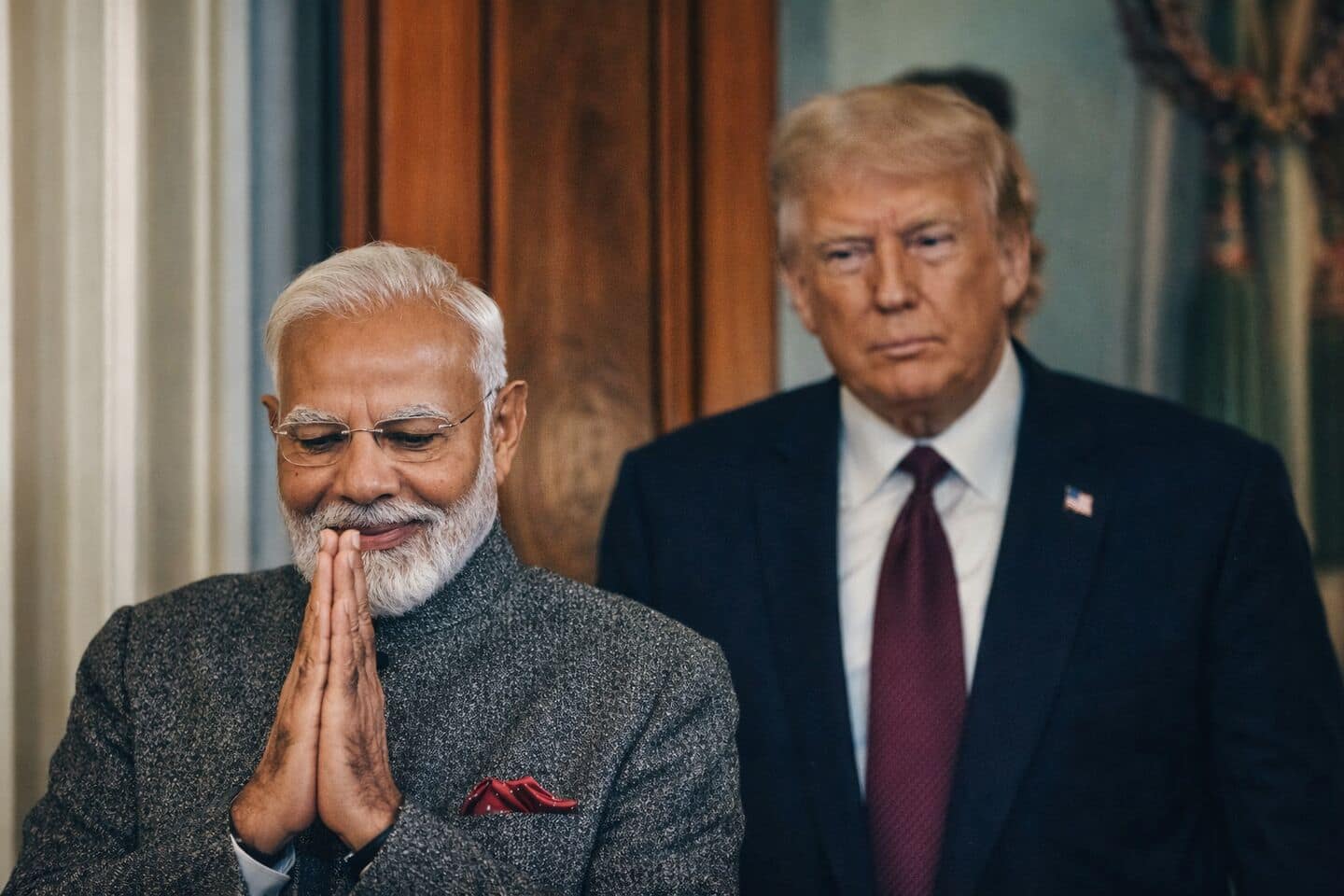
As Thomas Schelling once articulated to the US Congress, trade policy is intrinsically linked to national security policy. This understanding sheds light on why leaders like Donald Trump have opted to use tariffs as a tool to assert dominance. While some nations readily yielded to US pressure, countries like China, Brazil, and notably India, initially held firm. However, the recent resolution of the trade impasse with India suggests a potential capitulation, leaving many observers to question the true nature of the agreement and its long-term ramifications for India's autonomy and economic standing on the global stage.
Need for Transparency
In matters of national security, a government must not only act prudently but also be demonstrably seen to be doing so. Assertions and vague messaging are insufficient substitutes for clear intentions and defined purposes. Given that Parliament is currently in session, it would have been more appropriate for Prime Minister Narendra Modi to address the Lok Sabha directly regarding the trade deal, rather than allowing a diffused accountability between the Ministers of Commerce and External Affairs. Ultimately, on issues concerning international relations, whether economic or political, the ultimate responsibility rests with the Prime Minister. This contrasts with the approach taken in July 2005, when Prime Minister Manmohan Singh chose to address Parliament upon his return from Washington, D.C., providing a comprehensive account of his discussions with President George Bush concerning the civil nuclear energy agreement and India's energy security imperatives.
Lessons from the Past
The precedent set by Prime Minister Manmohan Singh concerning the US-India civil nuclear energy agreement offers a stark contrast to the current situation. For three years, Parliament engaged in extensive deliberations on every facet of the nuclear deal, allowing for thorough scrutiny and debate. Despite significant opposition, including from political parties like the Bharatiya Janata Party and even within the Congress party itself, Singh's commitment to transparency fostered trust among the Indian electorate, ultimately contributing to his electoral success in 2009. This emphasis on open discourse and clear communication stands in sharp contrast to the opacity surrounding the recent trade agreement with the US, where ambiguities persist, particularly regarding President Trump's claims about conditions on Russian oil purchases, which India has neither fully accepted nor outright rejected.
Ambiguity and Perception
The Modi government's handling of the final trade agreement with the United States has unfortunately led to significant ambiguity, particularly concerning President Trump's assertions about a conditionality related to India's purchase of Russian oil. India has neither definitively accepted nor rejected this claim. The foreign secretary’s subsequent statement, while diplomatic, has been open to various interpretations, with some commending it as Indian tact in the face of aggressive American posturing. However, this approach has also been perceived as duplicitous, with sophistry masquerading as astute statesmanship. Instead of celebrating the trade deal as a monumental achievement, the government should have forthrightly communicated that it represented the best possible outcome under the prevailing circumstances to protect livelihoods in India's export-oriented sectors.
Livelihoods Over Ideals
The motivation behind India's approach to the trade deal with the United States mirrors the rationale behind its withdrawal from the Regional Comprehensive Economic Partnership (RCEP). In the case of RCEP, India cited national interest, but the underlying concern was the protection of domestic industries and livelihoods that were deemed vulnerable to intensified global competition. Similarly, the trade agreement with the US appears to have been shaped by a desire to safeguard specific sectors. This is evident despite the government's earlier decision to restrict trade with Pakistan, which did not extend the same consideration to the livelihoods of Punjab's farmers, small and medium enterprises, and traders. The influence of industries like those in Surat and the shrimp farmers along the Coromandel Coast seems to have played a more significant role in shaping trade policy.
A Price Paid
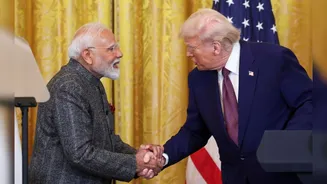
The recently concluded India-US trade deal, while perhaps the most favorable under the existing circumstances, should not be misconstrued as a concession granted to India. Rather, it represents the price India has agreed to pay to maintain amicable relations with the United States. This perception is likely to be widely shared globally. India has a history of yielding to pressure from major global powers, but this instance is notable for its portrayal as a significant accomplishment. The agreement serves as a stark reality check from the US, particularly following President Trump's earlier critiques and veiled threats towards Prime Minister Modi. Trump's deliberate framing of the trade deal as an Indian capitulation, by explicitly linking it to the cessation of Russian oil purchases, underscores the power dynamics at play.
Comparisons and Control
While it is understandable that governments often orchestrate support from think tanks and diplomatic circles, a critical distinction arises when comparing this trade deal to past negotiations, such as the civil nuclear agreement. During the nuclear deal discussions, American leadership did not resort to mocking Indian leadership. Even when India voluntarily curtailed oil imports from Iran to appease the American Jewish lobby, it was a temporary measure aimed at securing a long-term benefit – recognition as a nuclear weapons state. In contrast, the current trade agreement lacks clarity regarding its long-term stability. Other nations have also found themselves subject to constant uncertainty regarding their future relations with the US. The question remains whether India's support on various international fronts will be continuously tested, and whether it would still face repercussions for accessing Russian oil if geopolitical events in the Gulf disrupt its supply routes.
Call for Clarity
Significant uncertainties persist surrounding the recent trade agreement with the United States, prompting the government's classification of it as a 'Framework for an Interim Agreement.' It is imperative for the Prime Minister to provide a clear and honest explanation of India's current stance on its external economic policies, particularly in relation to both the United States and the BRICS nations. This transparency is crucial to move beyond veiled pronouncements and fabricated displays of strategic acumen, such as the notion of being 'Chanakyan.' Open communication regarding India's strategic direction will foster greater trust and understanding both domestically and internationally, ensuring that the nation's economic and foreign policy decisions are well-informed and clearly articulated to the public.