



A Breakfast of Contrasts
Every region boasts its signature morning meal, from Mumbai's vada pav to Delhi's chole bhature. Yet, in the bustling heart of Madhya Pradesh, specifically
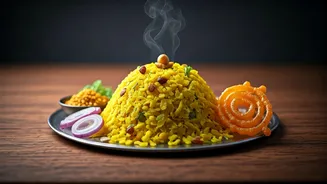
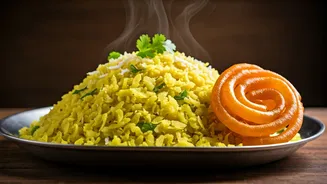
the vibrant cities of Indore and Bhopal, a breakfast pairing defies conventional logic: poha and jalebi. This combination marries the humble, savory notes of flattened rice with the sticky, sweet allure of a deep-fried delight. While on paper they appear to be odd bedfellows, on the plate, they create a harmonious symphony of flavors and textures. Poha-jalebi transcends mere sustenance; it's a daily ritual, a cornerstone of local identity, and a taste of history that most may not have considered. The definitive answer to its origin often points to Indore, though Bhopal fiercely claims it too, and the entire Malwa region holds this unique breakfast combination in high regard.
Tracing Poha's Roots
The genesis of Indori poha, a distinct preparation of flattened rice, is widely attributed to the metropolis of Indore itself, believed to have emerged in the post-independence era. However, poha’s presence in Indore isn't an isolated culinary event; it's intertwined with the city's historical trajectory. Indore’s origins trace back to the 16th century as a crucial trading nexus connecting the Deccan plateau with Delhi. The region subsequently fell under the sway of the Maratha Empire on May 18, 1724, when the Maratha Peshwa asserted full dominion over Malwa. It was the Marathas who introduced poha into this narrative. Their migration from Maharashtra, a region where poha enjoys significant popularity, to Madhya Pradesh, brought along cherished culinary traditions like shrikhand and, of course, poha. This culinary migration suggests that Maratha warriors disseminated these dishes as they ventured into North India and the Malwa region, much like a ruling dynasty implanting its food habits, employing its cooks, and introducing its ingredients, allowing those flavors to flourish in new territory.
Indore's Unique Poha Style
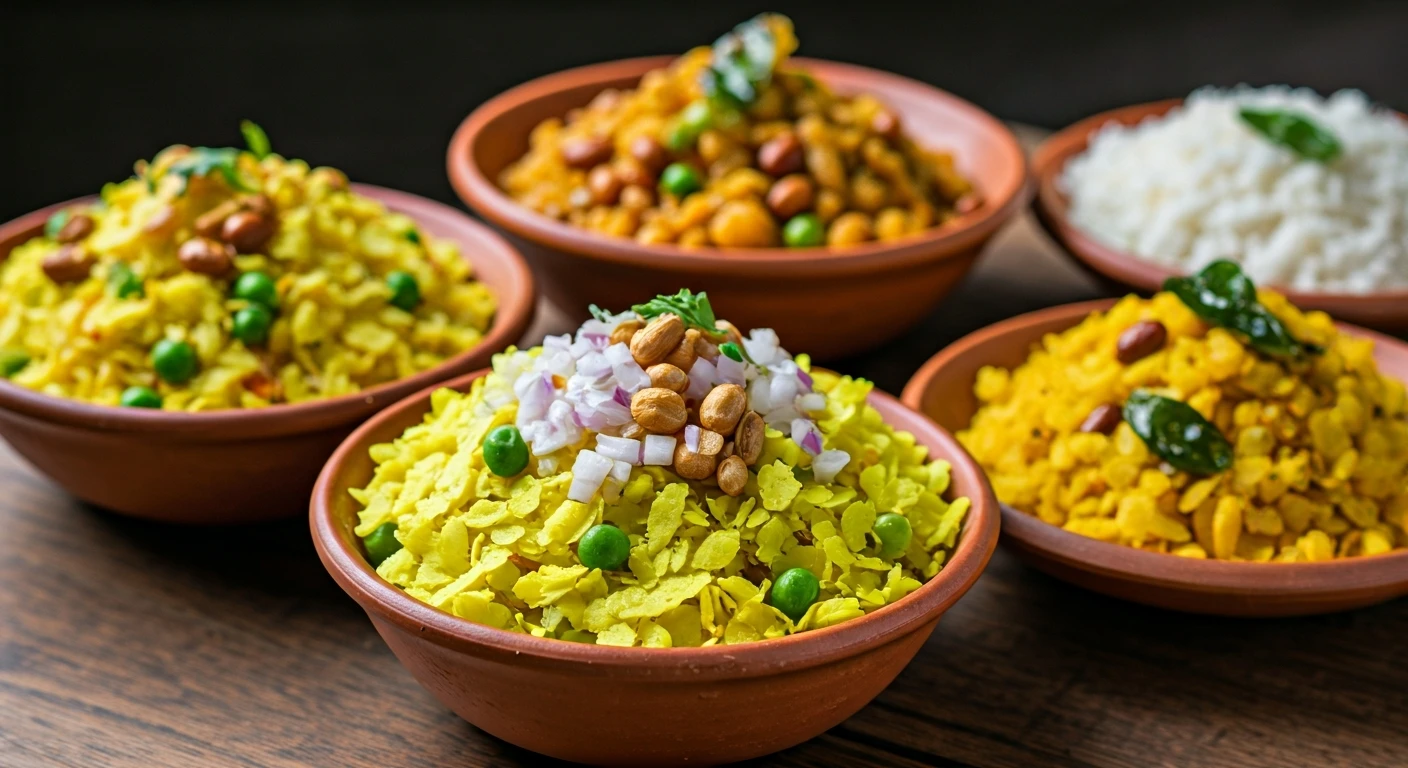
While poha is a widely popular dish across India, with variations found in Maharashtra, Gujarat, and beyond, Indore's version distinguishes itself through an innovative preparation technique. Unlike the common pan-cooking method used elsewhere, Indori poha is steamed. This steaming process imbues the flattened rice with a unique softness, a distinct taste, and an enhanced flavor profile. The preparation involves seasoning the rinsed poha, followed by a tempering of spices, and then steaming the mixture, resulting in a lighter and more wonderfully fluffy dish. The distinct flavor of Indori poha is further elevated by the subtle sweetness and fragrant aroma of fennel seeds. It is typically crowned with a generous topping of sev or bhujiya, a crispy snack crafted from gram flour and a blend of spices. While Maharashtrian poha often incorporates ingredients like coconut, coriander, potatoes, and onions, the Indore iteration, hailing from the Nimar-Malwa region, is often garnished with crushed kachori, bhujia sev, or even jalebis, adding layers of texture and taste.
The Artful Garnishes
The garnishes adorning Indori poha are a highlight, often featuring crispy jalebis, crunchy sev, a savory usal, finely sliced onions, and a sprinkle of fennel seeds. A unique element is the dash of Jeerawan powder, an exclusive spice blend characteristic of Indore. This proprietary mix comprises roughly 20 different spices, rendering it distinct from generic chaat masalas and fundamental to the dish's identity. The sheer popularity and cultural significance of Indore poha were formally recognized in 2017 when India Post issued a commemorative stamp in its honor, solidifying its status as a cherished and traditional culinary treasure within the nation.
Jalebi's Ancient Journey
The inclusion of jalebi in this breakfast combination is not arbitrary but carries a history far richer than many realize. Originating in the Middle East as 'Zalabiya,' this sweet treat was prepared by frying a fermented wheat batter and then immersing it in honey or sugar syrup. Its presence is documented in medieval Arabic cookbooks, such as the 'Kitab al-Tabikh' by Ibn Sayyar al-Warraq dating back to the 10th century, and later by Muhammad bin Hasan al-Baghdadi in the 13th century. Turkish and Persian traders are credited with introducing Zalabiya to India, where it eventually evolved into the familiar 'jalebi.' By the 15th century, it had become an integral part of Indian culture, commonly served during festivals, weddings, and temple ceremonies. The earliest mention of jalebi in an Indian context appears in the 'Priyamkarnrpakatha' (1450 CE), a Jain text authored by Jinasura, where it is listed as part of a merchant's dinner menu. Thus, jalebi has been a component of Indian gastronomy for at least six centuries. By the time it reached Madhya Pradesh, it had already traversed through Persian kitchens, Turkish trading posts, and the opulent Mughal courts, absorbing influences along its path.
A Fusion of Cultures
Bhopal, with its pronounced Mughal heritage, is renowned for its culinary offerings such as shahi tukda and kebabs. The pairing of jalebi with poha in this region reflects a broader cultural fusion, presenting a breakfast that beautifully encapsulates the diverse cultural geography of Central India. One component draws its lineage from Maratha rulers originating in Maharashtra, while the other reflects Persian and Mughal influences. Both these distinct culinary streams converge harmoniously in Madhya Pradesh. Food combinations endure only if they are successful, and the poha-jalebi pairing achieves this in a remarkably specific and localized manner. It stands as the quintessential breakfast of the Malwa region, uniting two disparate dishes into a popular entity. Indore's culinary identity is a rich tapestry woven from Maharashtrian, Malwi, Rajasthani, and Gujarati influences. This very blend explains the successful synergy of the poha-jalebi pairing. The Malwa palate is accustomed to embracing contrasts—sweet and sour, spicy and cooling, crunchy and soft. The tangy zest of poha set against the syrupy sweetness of jalebi is not an alien concept within this context; rather, it is the natural culmination of a food culture built upon intricate layers of flavor.
Street Food Charm
In Indore, Indori poha is predominantly sold by vendors throughout the morning, often alongside other beloved local snacks such as kachori and samosas. The street food culture in Indore is taken with utmost seriousness; it's a city that deeply values its culinary identity, with the poha-jalebi cart being as integral to this identity as the historic Sarafa Bazaar and Chappan Dukan. While poha-jalebi is now also available in sit-down eateries, with some restaurants offering commendable versions, the truly authentic experience involves standing by a bustling street cart in the early morning, a paper plate in hand, with the sweet syrup of jalebi threatening to cascade down your wrist. The Indore Mithai Aur Namkeen-Vikreta Vyapari Sangh (IMANVMS), an organization representing sweets and snacks manufacturers, initiated the documentation of four prominent food items from the Malwa region in 2019, including Indori poha. This effort aims to secure Geographical Indication (GI) tags for these culinary specialties. Should this endeavor succeed, Indori poha-jalebi would join an exclusive cadre of Indian breakfast dishes with official protected status, a recognition that seems entirely fitting given its profound cultural representation.
Bhopal's Distinct Touch
Bhopal's connection with poha-jalebi presents a slightly different narrative compared to Indore's. Residents in Bhopal often form queues even as vendors are just beginning to set up their stalls. The jalebis here are noted for their delightful crispness and juiciness, perfectly complementing the tangy and spicy poha. Bhopal's rendition tends to lean more towards spicier notes, influenced by Mughal seasonings and featuring a subtly different garnish profile. Despite the cities being only a couple of hours apart, their poha variations are distinct enough that regulars can readily identify and articulate their preference for one over the other. Neither city's interpretation is inherently 'wrong'; that is precisely the essence of this dish. It has, wherever it has settled, absorbed the surrounding culture and adopted a taste unique to that specific locale. The fennel-forward, sev-laden Indori version and the tangier, spicier Bhopali iteration are both considered authentic, each reflecting unique dialogues between the same ingredients and two very different urban environments.
A Taste of Heritage
To savor poha-jalebi in either Indore or Bhopal is to partake in a culinary creation shaped by the historical currents of Maratha migration, Persian trade routes, Mughal kitchens, and the distinctive ingenuity of a food culture that masterfully transforms imported ingredients into something entirely its own. This is not a fleeting trend, nor a special occasion dish, nor a mere food festival attraction. It is, fundamentally, a daily morning meal that has been consumed on these very streets, from similar kinds of carts, for generations. The combination that might appear illogical on the surface is, in fact, the very essence of a culinary experience that, once tasted, compels one to seek it out elsewhere, often with the realization that its authentic charm is inimitable.