








Rupee's Recent Struggles
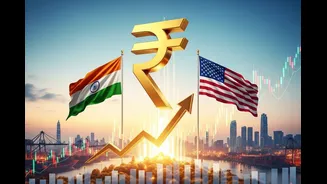
The Indian Rupee has experienced significant weakening, with its decline being among the steepest seen since past financial crises. This situation has prompted
a closer examination of the various factors contributing to this trend and what it means for India's economic health. The weakening of the Rupee isn't a new phenomenon; however, its magnitude and the current economic landscape demand a detailed analysis. The decline is not just a blip but a pattern that requires careful consideration of its effects across different sectors and on various economic indicators. This also necessitates the scrutiny of both internal and external factors influencing the Rupee's value.
Impact on Exports
A weaker Rupee often provides a boost to exports, making Indian goods and services more competitive in international markets. This can lead to increased demand, higher revenues for exporters, and a positive effect on the overall trade balance. For Indian exporters, a depreciating Rupee means that they receive more Rupees for every dollar or other foreign currency they earn. This enhances their profitability, potentially enabling them to expand operations, invest in new technologies, and hire more workers. This advantage is, however, not without potential drawbacks, since the increased costs of imports could diminish some of the gains from exports. Despite these benefits, it is crucial to understand that the positive effects on exports can be influenced by various global economic factors.
5 Channels of Impact
Bank of America (BofA) has pinpointed five channels through which the Rupee's weakness is impacting the Indian economy. These channels represent various vulnerabilities and risk points that warrant close monitoring. The impact of a weakening Rupee is not uniform. The five channels include aspects like external balances, which refer to a country's financial transactions with the rest of the world. Capital flows can also be affected, encompassing the movement of investments into and out of India. Further impacting areas like inflation, this situation can raise the price of imported goods. Finally, this situation increases financial risks and poses issues to policy planning, thereby making it critical to examine the interplay of these channels for a comprehensive grasp of the impact.
Capital Flows Under Strain
The weakness of the Rupee is putting capital flows under strain. When the Rupee declines, it can deter foreign investors, since their returns are reduced when converted back into their home currencies. This is because they might see their investment diminishing in value due to currency depreciation. This decrease in foreign investment can have several consequences. For instance, it can weaken the Rupee further. Additionally, it can create difficulties in financing the country’s current account deficit. The strain on capital flows is not only an economic concern but also a financial one, which has implications for India’s economic stability. The outflow of capital becomes more likely and the access to international financing could get more difficult. It's imperative that policymakers closely monitor and take proactive measures.
External Balance Improvements?
Despite the challenges, there is cautious optimism that external balances may improve over the coming quarters. External balances involve the difference between a country's foreign income and its spending. Several factors could contribute to this positive outlook. One is the boost to exports that a weaker Rupee provides, as highlighted earlier. As exports become more competitive, the trade deficit might decrease, which could eventually strengthen the external balance. Furthermore, a slowdown in import demand due to a weaker currency can help reduce the amount spent on imports. Such developments are crucial for bolstering the country’s economic health. This is because improvements in the external balance indicate enhanced stability and resilience against external economic shocks. The projected improvement in the external balance is seen by strategists as a positive indicator, suggesting that the Indian economy may adjust to the current challenges.
Future Appreciation Outlook
Financial strategists anticipate a moderate appreciation of the Rupee in the coming year. These expectations are based on assessments of economic fundamentals, market trends, and policy interventions. However, the path to appreciation will likely involve volatility. Various factors can influence the Rupee’s appreciation, including global economic conditions, the health of the Indian economy, and changes in investor sentiment. The pace and degree of appreciation are difficult to predict, since they depend on a complex array of global and local factors. This is a common and reasonable expectation. The future of the Rupee is always difficult to predict. The appreciation of the Rupee can improve India's financial stability by stabilizing the external balances, making imports more affordable, and fostering investor confidence. The outlook for appreciation, though, is subject to change.