






From Slow Start
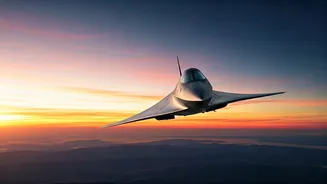
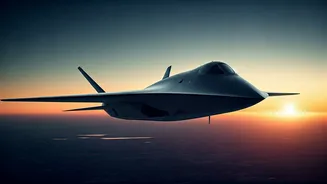
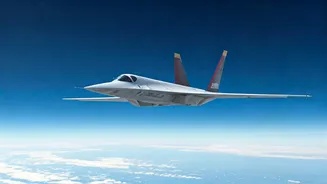
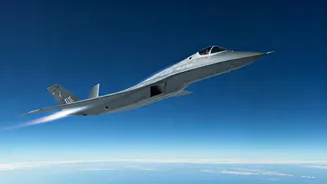
The experimental X-59 aircraft has undergone a significant transformation, evolving from its initial cautious test flights to achieving remarkable near-supersonic
speeds. In its early stages, starting in October 2025, the aircraft barely exceeded 230 mph while operating at a modest 12,000 feet. However, through a series of nine carefully orchestrated test flights, the X-59 has dramatically escalated its performance envelope. The most recent and aggressive test involved maneuvers at an impressive 43,000 feet, reaching speeds of 627 mph, which is equivalent to Mach 0.95 – tantalizingly close to the speed of sound. During these advanced trials, the pilot executed complex aerobatic maneuvers, including dramatic pitch oscillations resembling a rollercoaster and rapid bank-to-bank auto rolls. These aren't mere aerial acrobatics; each specific maneuver is designed to gather crucial data. For instance, flutter excitation tests are conducted to assess and prevent dangerous structural vibrations that can occur at high velocities. Additionally, tests involving landing gear deployment are essential to measure how the physical presence of extended wheels impacts the aircraft's aerodynamic characteristics. This systematic approach to expanding the flight envelope validates the 99.7-foot aircraft's ability to safely withstand the extreme conditions required for its ultimate mission objective.
Silence the Boom
For over five decades, the disruptive sonic boom generated by supersonic aircraft has been the primary reason for regulatory restrictions, preventing them from flying over continental landmasses since 1973. Traditional supersonic jets produce a distinct and loud 'double-bang' sound, a phenomenon that has kept passenger flights limited to subsonic speeds for transcontinental journeys, thus doubling travel times. The X-59 tackles this challenge with groundbreaking acoustic engineering. Its design features a uniquely elongated nose, stretching nearly half the length of the aircraft. This innovative shape is engineered to meticulously manage and disperse the pressure waves that form at supersonic speeds, spreading them out over a broader area and time. Instead of concentrating these waves into sharp shock fronts that create the explosive boom, the X-59's design aims to transform the sound. Coupled with the strategic placement of its engines on the upper fuselage, this specialized aerodynamic shaping is intended to convert the familiar sonic boom into a significantly quieter sound, which NASA describes as a soft 'thump'. This acoustic transformation is crucial, as it could potentially meet the noise tolerance levels of noise-sensitive communities and regulators, paving the way for future FAA approval for supersonic flights over land.
Future of Travel
The successful flight tests of the X-59 hold the potential to redefine commercial air travel, promising to drastically reduce journey times across continents. A flight that currently takes approximately seven hours, such as from New York to London, could be cut in half, to just three and a half hours. The development of the X-59 represents a substantial investment of $518 million, and its purpose extends beyond mere aeronautical advancement; it serves as a critical tool to overcome regulatory barriers. NASA's strategy involves gathering empirical data through extensive community overflight testing in selected locations across the United States. The collected human response data regarding the quieter sonic signature will be instrumental in persuading regulators to establish new noise-based standards for supersonic flight, with a target of 2027. If these tests prove successful and the noise is deemed acceptable, this could finally enable supersonic passenger jets to operate domestically, fulfilling the futuristic promises of rapid travel envisioned by concepts like the Jetsons. The objective is to demonstrate that supersonic flight can be achieved without the disruptive sonic booms of the past, making faster air travel a widespread reality for passengers.