




A New Reef Guardian
Coral reefs, the vibrant cities of our oceans, are facing unprecedented threats from climate change, overfishing, and human development. These critical
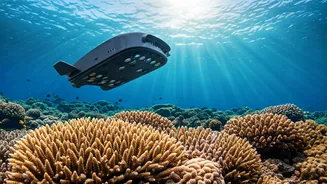
ecosystems, though occupying less than 0.1% of the ocean floor, are home to an astonishing 25% of all marine life. To effectively protect them, scientists need precise and up-to-date information about their inhabitants. Traditionally, this task falls to human divers, whose capabilities are limited by their need for air, time constraints, and the significant cost associated with training and equipment. This is where the Curious Underwater Robot for Ecosystem Exploration, or CUREE, emerges as a revolutionary solution. Developed by the Woods Hole Oceanographic Institution, CUREE is an autonomous, multi-sensor survey robot designed to navigate and gather extensive data about reef ecosystems with remarkable efficiency. Its sophisticated technology promises to overcome many of the challenges faced by human researchers, offering a more comprehensive and continuous understanding of reef health and biodiversity.
CUREE's Smart Sensors
CUREE is equipped with an impressive array of sensors, enabling it to perceive its environment in ways that go far beyond visual observation. It utilizes hydrophones to detect subtle underwater sounds, such as the communications between fish, and high-resolution cameras for detailed visual analysis. An onboard computer processes this incoming data in real-time, allowing CUREE to identify potential areas of high marine activity, often referred to as 'hotspots.' The robot can then autonomously navigate towards these promising locations, moving closer to gather more specific information. This dual-sensor approach, combining passive acoustics for broad environmental awareness with rich visual data for detailed examination, is what makes CUREE particularly effective. As roboticist Yogesh Girdhar from WHOI notes, these sensing modalities perfectly complement each other, providing a comprehensive picture of the reef's complex biological landscape. This capability allows CUREE to generate data-rich maps, revealing the distribution and behavior of marine life with an accuracy and speed that would be exceptionally difficult for human divers to achieve.
Autonomous Exploration in Action
In a series of real-world tests conducted near Joel's Shoal in the U.S. Virgin Islands, CUREE demonstrated its impressive autonomous capabilities. The robot was able to successfully pinpoint and count fish in specific areas, detecting their presence from as far as 82 feet away, thereby identifying marine life hotspots. Even more remarkably, CUREE managed to track a barracuda for an extended period. The robot locked onto the predator and followed it for an impressive nine minutes and 55 seconds. During this pursuit, the barracuda moved between different locations, including a known hotspot and an area where it had previously startled a reef snapper. While initial human intervention was required for CUREE to lock onto the barracuda, and occasional re-locking was necessary, the majority of the tracking – a remarkable eight minutes and 59 seconds – was performed entirely autonomously. This successful autonomous tracking showcases CUREE's advanced navigation and object-following abilities, proving its potential to conduct extensive surveys without constant human oversight, significantly advancing the study of coral reef ecosystems.