





Core Working Principles
The fundamental distinction between induction and infrared cooktops lies in their heating mechanisms. Induction technology harnesses electromagnetic energy.
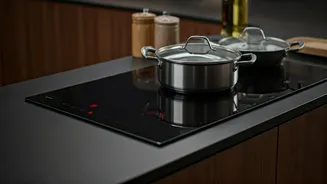
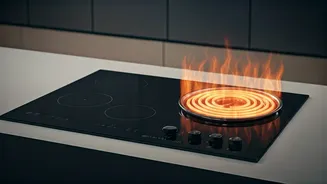
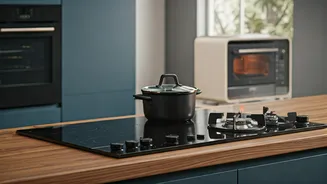
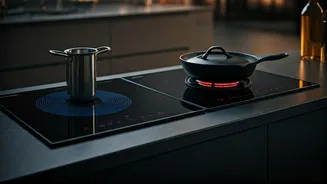
Beneath its glass surface, a copper coil generates a magnetic field. When a pot or pan with a magnetic base is placed on it, this field creates an electrical current directly within the cookware, generating heat. Consequently, the cooktop surface itself remains relatively cool, only warming from residual heat transferred back from the pan. This direct heating of the vessel makes induction highly energy-efficient, with minimal energy wasted on heating the surrounding environment. In stark contrast, infrared cooktops operate by heating the glass surface directly, typically using a halogen lamp or a heating element situated below. This heated surface then radiates thermal energy upwards to warm the cookware placed upon it. While functioning somewhat like a conventional electric coil stove, infrared offers more uniform heat distribution and efficiency. The surface gets hot, transferring heat to the vessel and subsequently cooking the food, a more intuitive and familiar process for many users.
Cookware Compatibility Explained
The most significant practical differentiator, particularly for Indian kitchens, is cookware compatibility. Induction cooktops strictly require magnetic cookware. A simple test involves using a refrigerator magnet; if it adheres firmly to the pan's base, it's induction-compatible. Suitable materials include cast iron, carbon steel, enamelled iron, and specific stainless steel grades with magnetic bases. Many modern Indian pressure cookers and flat-bottomed tawas and kadhais are designed to work with induction. However, common Indian kitchen staples like plain aluminium, copper, glass, ceramic, and non-magnetic stainless steel cookware will not function on an induction surface unless they have an added induction-compatible base. This often necessitates a considerable investment in new cookware for households that predominantly use these traditional materials. Infrared cooktops, on the other hand, are far more accommodating. Since they heat the cooktop surface which then heats the vessel via contact, they work with a broad spectrum of cookware, including aluminium, glass, ceramic, and most flat-bottomed pots and pans, regardless of magnetic properties. This flexibility allows users to retain their existing collection of cookware. A shared limitation for both technologies, however, is their preference for flat-bottomed vessels. Traditional rounded-base kadhais, often used for deep-frying, can pose issues on induction by not being detected by the sensors, and on infrared, they lead to uneven heating due to poor contact with the glass surface. For optimal results, a flat-bottomed kadhai or a wok with a stable base is recommended for both.
Performance for Indian Cooking
When it comes to the actual cooking process, induction generally offers superior speed and heat control, which are crucial for many Indian culinary techniques. Induction heats up considerably faster than infrared because it directly energizes the cookware. This speed is beneficial for tasks like bringing water to a boil quickly, heating oil for a tadka, or reaching pressure in a cooker. Furthermore, induction provides exceptionally precise temperature regulation. Adjustments to the magnetic field can be made almost instantaneously, allowing for swift transitions from high-heat sautéing to a gentle simmer. This fine control is invaluable for dishes like bhuna masalas, where precise heat management is key to avoiding burning. Infrared, while offering a more familiar experience, responds more slowly to temperature changes and retains residual heat in its surface, making extremely fine control more challenging. In terms of even heating, infrared might have a slight advantage, as its radiant heat tends to distribute more uniformly across the vessel's base. Induction can sometimes create hot spots, particularly in certain cookware types. For the quintessential Indian tadka, both can perform adequately, but induction's speed and responsiveness give it an edge. Replicating the puffing of phulkas and rotis, typically achieved over an open gas flame, is difficult on both electric platforms. While rotis can be cooked on a tawa, achieving that perfect puff requires practice and potentially using a thick tawa or a wire mesh. Critically, neither induction nor infrared can replicate the smoky char obtained from roasting vegetables like brinjal directly over a gas flame. This specific flavour profile would necessitate alternative methods such as using an oven grill, an air fryer, or the traditional dhungar technique.
Efficiency, Safety, and Costs
Induction cooktops stand out for their exceptional energy efficiency, capable of transferring up to 90% of their generated energy directly into the cookware, significantly reducing waste heat. Infrared cooktops, while more efficient than older electric coil models, still dissipate energy through the heated glass surface and surrounding air. Over time, this energy conservation with induction can lead to noticeable reductions in electricity bills. Safety is another key advantage for induction, especially in households with children or the elderly. The cooktop surface remains cool to the touch, minimizing burn risks, unlike infrared surfaces that stay hot long after being switched off. Many induction units also incorporate advanced safety features like child locks and automatic shut-off functions. Both technologies are inherently safer than gas stoves, eliminating risks associated with gas leaks and open flames. Regarding initial cost, infrared cooktops are typically more budget-friendly, with entry-level models often priced lower than comparable induction units. However, the need to purchase new induction-compatible cookware can increase the upfront investment for induction. Despite this, the long-term energy savings offered by induction can offset the higher initial cost over time, making it a financially viable choice for consistent daily use.
Making the Right Choice
The decision between an induction and an infrared cooktop hinges on your specific needs and kitchen habits. Opt for induction if your current cookware primarily consists of stainless steel or cast iron, or if you are prepared to invest in induction-compatible vessels. You should also consider induction if you prioritize rapid cooking times and precise temperature control, and if safety is a paramount concern in your household. Conversely, choose infrared if you have a diverse collection of existing cookware, including aluminium and other non-magnetic materials, that you wish to continue using. It's also a practical choice if you are operating on a tighter initial budget or simply prefer a more straightforward cooking experience that doesn't involve checking cookware compatibility. Ultimately, both technologies represent significant upgrades over older electric stove options and can serve an Indian kitchen effectively once their operational requirements are understood. Many experienced Indian home cooks find induction to be superior after an adjustment period, largely due to its speed and fine-tuned control. Nevertheless, infrared remains a flexible and accessible option, particularly for kitchens that rely on a wide array of cookware accumulated over many years. A thoughtful assessment of your own kitchen's inventory and cooking style is the most effective way to make the correct decision.