


Understanding Lunar Eclipses
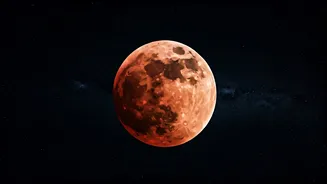
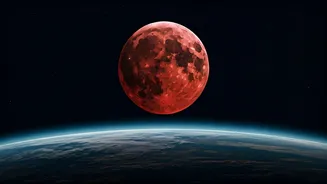
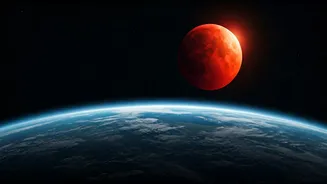
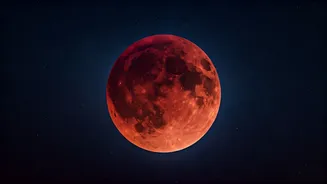
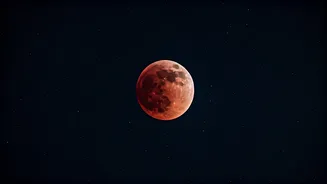
A total lunar eclipse, often referred to as a 'blood moon,' is a captivating astronomical occurrence that unfolds when the Earth positions itself directly
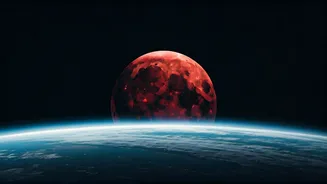
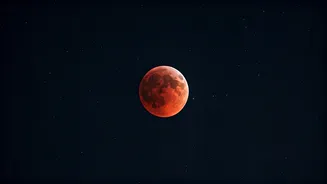
between the sun and the moon. This alignment causes Earth's shadow to fall upon the lunar surface. The phenomenon is intrinsically linked to the full moon phase. Earth's shadow is comprised of two distinct parts: the umbra, its darkest, central region, and the penumbra, a fainter, outer halo. For a total lunar eclipse to transpire, the moon must completely traverse through the dense umbra. This cosmic dance results in the moon taking on a reddish or coppery hue, a mesmerizing effect attributed to the way sunlight refracts and scatters through Earth's atmosphere.
The 'Blood Moon' Phenomenon
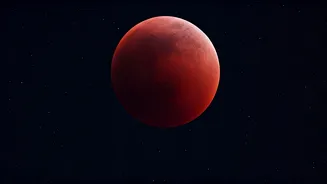
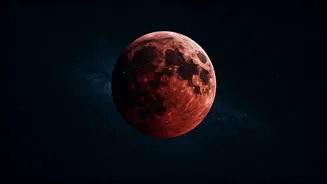
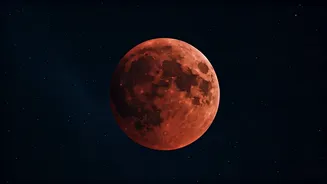
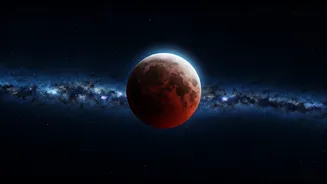
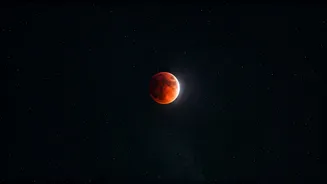
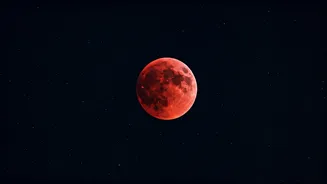
The distinctive reddish coloration observed during a total lunar eclipse, often dubbed the 'blood moon,' is a direct consequence of atmospheric optics. While the moon doesn't vanish entirely, it absorbs and reflects sunlight that has been filtered and bent by Earth's atmosphere. Specifically, shorter wavelengths of sunlight, like blue and violet, are scattered away, allowing the longer, red wavelengths to pass through and illuminate the moon. The precise shade and intensity of this red hue are influenced by the atmospheric conditions on Earth at the time of the eclipse, such as the density of dust particles and cloud cover. This makes each 'blood moon' a unique visual event.
Asia-Pacific Viewing Times
The total lunar eclipse on March 3, 2026, promises a stunning display for viewers across the Asia-Pacific region. While the eclipse occurs simultaneously worldwide in Universal Time Coordinated (UTC), local timings and moon visibility will vary significantly by location. For New Zealand, totality will be visible from 12:04 a.m. to 1:02 a.m. NZDT on March 4th. Residents of Sydney will experience this phase between 10:04 p.m. and 11:02 p.m. AEDT on March 3rd. In Brisbane, the timings are 9:04 p.m. to 10:02 p.m. AEST on March 3rd, while Adelaide will see it from 9:34 p.m. to 10:32 p.m. ACDT on the same evening. Darwin viewers can catch the event from 8:34 p.m. to 9:32 p.m. on March 3rd, and Perth from 7:04 p.m. to 8:02 p.m. on March 3rd. Further north, Tokyo and Seoul will witness totality from 8:04 p.m. to 9:02 p.m. JST and KST respectively on March 3rd. Beijing and Hong Kong will experience this celestial marvel between 7:04 p.m. and 8:02 p.m. CST and HKT on March 3rd, respectively. It's important to note that in some parts of Southeast Asia, totality might coincide with moonrise, potentially affecting the initial viewing experience.
Observing the Eclipse
Witnessing a total lunar eclipse is an accessible and awe-inspiring experience, as it requires no specialized equipment. Unlike solar eclipses, lunar eclipses are perfectly safe to view with the naked eye. To enhance the visual experience, one might consider using binoculars or a telescope, which can reveal finer details on the moon's surface and its shadowed regions. The most crucial factor for optimal viewing is finding a location with minimal light pollution, offering an unobstructed panorama of the night sky. Consulting local astronomical websites or mobile applications is highly recommended to obtain precise timings for the eclipse's various phases, including the start, end, and duration of totality, tailored to your specific geographic coordinates. Clear skies are, of course, paramount for enjoying this cosmic spectacle.