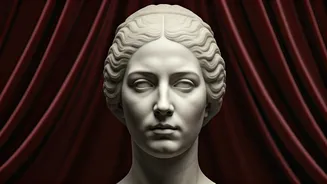







Beauty's Broad Horizon
During the medieval and Renaissance periods in Europe, a higher forehead was not merely accepted but actively admired as a hallmark of exceptional beauty
and refined elegance. This prominent facial feature was strongly associated with intellectual prowess and sophistication, making it a desirable trait among those seeking to project an image of intelligence and high social standing. The emphasis on a larger forehead conveyed a sense of wisdom and grace, aligning with the prevailing aesthetic ideals of the time. This perception elevated the forehead beyond a simple physical attribute to a symbol of inner qualities and societal aspirations, influencing how individuals presented themselves and how artists chose to depict them.
Fashion's Forehead Focus
The prevailing fashion trends of the era played a significant role in accentuating the forehead's appearance in portraits. Elaborate head coverings and meticulously styled hairstyles were intentionally designed to draw attention upwards, thereby exposing and seemingly enlarging the forehead. These sartorial choices were not arbitrary; they were carefully crafted to enhance the perceived size and prominence of this facial area. By framing the face in ways that minimized hair near the temples and hairline, people aimed to present a more expansive and therefore more attractive forehead, aligning with the era's beauty standards and artistic conventions. This deliberate styling turned a physical feature into a conscious fashion statement.
The Art of Illusion
Beyond styling and fashion, many women actively modified their appearance to achieve the coveted high forehead. This often involved the practice of plucking or even shaving the front edges of their hairlines. The goal was to create a visually extended forehead, an aesthetic manipulation mirroring some contemporary beauty practices aimed at altering perceived facial proportions. This was not about embracing a natural look but about actively crafting an idealized one. The effort invested in altering hairlines underscores the significant cultural importance placed on a prominent forehead as an indicator of beauty and desirability within those historical societies, demonstrating a proactive approach to beauty standards.
Artists' Idealised Views
When it came to portraiture, painters frequently moved beyond strict photographic realism to depict their subjects according to the prevailing beauty ideals. A common artistic practice involved subtly enhancing or enlarging features, and the forehead was a prime candidate for such idealization. Artists would strategically manipulate perspective and proportion to emphasize a higher forehead, believing it contributed to a more noble and attractive portrayal. This artistic liberty allowed them to capture not just a likeness, but a representation that resonated with the cultural understanding of beauty and status, making the paintings aspirational rather than purely documentary in their depiction of individuals.
A Culturally Specific Trend
It is crucial to recognize that the emphasis on high foreheads was not a universal phenomenon. This particular beauty standard and its artistic representation were largely confined to European art and culture during specific historical periods. Different civilizations and regions across the globe maintained their own distinct aesthetic preferences and artistic styles for portraiture. Therefore, the prominent foreheads seen in Western Renaissance paintings reflect a localized cultural ideal, rather than an objective measure of beauty applicable everywhere. Understanding this context highlights the diversity of human aesthetic values throughout history and across different societies.
Intellect and Status Symbol
The association of a larger forehead with intelligence and noble lineage cemented its status as a highly desirable attribute, particularly among the affluent and educated classes. This connection between physical appearance and perceived mental acuity or social standing meant that a prominent forehead was not just about beauty, but also about projecting intellect, wisdom, and a distinguished background. For those in positions of power or influence, emphasizing this feature in portraits served as a visual cue to their societal importance and intellectual capabilities, reinforcing their elite status within the hierarchical structures of the time. It was a powerful symbolic representation.