





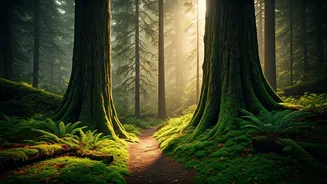
Daintree's Ancient Roots
Imagine standing in a rainforest so old it predates the dinosaurs. Daintree, estimated at a staggering 180 million years, is the planet's oldest tropical
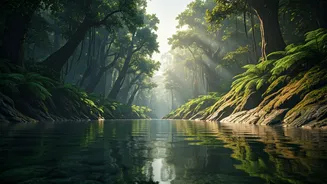
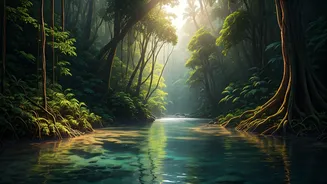
rainforest. Its ancient lineage is evident in its flora, showcasing plant species that have persisted since the Mesozoic era. Walking through Daintree is like entering a living museum, where primitive plant forms offer a direct connection to Earth's distant past. The sheer age and unique evolutionary history make it an unparalleled natural heritage site, holding secrets of a world long gone yet vibrantly alive.
Borneo's Rich Tapestry
Borneo Lowland Rainforest, a treasure dating back approximately 130 million years, spans across Malaysia, Indonesia, and Brunei. This ancient ecosystem is renowned for its extraordinary biodiversity, supporting a complex web of life. It serves as a critical habitat for iconic species such as orangutans and pygmy elephants, highlighting its immense ecological significance. The sheer age and complexity of this rainforest contribute to its status as one of the most biologically rich regions on Earth, a testament to millions of years of undisturbed evolution and ecological balance.
Taman Negara's Primal Charm
Often recognized as one of the globe's most ancient rainforests, Taman Negara boasts an age exceeding 130 million years. This pristine ecosystem offers visitors an immersive experience through its dense jungle trails and elevated canopy walkways. Exploring Taman Negara allows for a profound connection with nature, revealing a landscape that has remained largely unchanged for eons. Its sustained ecological integrity and the sheer antiquity of its environment make it a remarkable destination for those seeking to witness nature's enduring power and intricate beauty.
Amazon's Enduring Majesty
While younger than some of its ancient counterparts, the Amazon Rainforest, at over 55 million years old, commands its place as the largest and most biodiverse on Earth. Its vast expanse hosts an unparalleled array of plant and animal species, a testament to its long evolutionary history. The sheer scale and richness of life within the Amazon make it a crucial global ecosystem. Its enduring presence and continuous ecological processes underscore its vital role in planetary health and its status as an irreplaceable natural wonder.
Yakushima's Mystical Cedars
Yakushima Forest is a realm of enchantment, famously home to ancient cedar trees that can be over 7,000 years old. These venerable giants, often shrouded in mist and adorned with vibrant moss, create a surreal and almost magical atmosphere. This unique environment was so inspiring that it served as a muse for acclaimed animated films. Exploring Yakushima offers a deeply spiritual connection to nature, where time seems to stand still amidst the silent wisdom of these ageless trees and the ethereal beauty of their surroundings.
Bristlecone Pine Resilience
The Ancient Bristlecone Pine Forest stands as a profound testament to resilience and endurance. It is home to some of the oldest living trees on the planet, with individuals exceeding 5,000 years of age. This rugged forest thrives in extreme climatic conditions, showcasing the remarkable ability of life to adapt and persist over vast spans of time. The gnarled and weathered appearance of these ancient pines tells a story of survival against all odds, making it a place of awe and contemplation about life's tenacity.
Caspian Hyrcanian Relics
These lush forests, dating back an impressive 25 to 50 million years, are ecological relics of immense significance. The Caspian Hyrcanian Forests once stretched across a substantial portion of the Northern Hemisphere, representing a vast ancient biome. Their survival makes them invaluable living archives of past climates and ecosystems. Today, these forests provide a unique window into Earth's geological and biological history, preserving a lineage of flora that has witnessed countless transformations over millions of years.
Reunion's Volcanic Forests
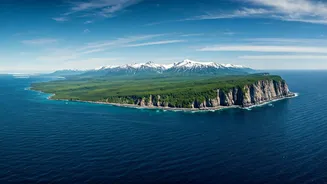
Although geologically younger than others on this list, Reunion National Park, established around 2 to 2.5 million years ago, presents a unique ancient ecosystem. Its dramatic volcanic landscapes are cloaked in dense, ancient forests, creating a striking contrast between fiery geological origins and verdant life. This juxtaposition of primal forces and enduring nature offers a distinct experience, showcasing how life reclaims and thrives even in the shadow of recent volcanic activity, forming a visually spectacular and ecologically intriguing environment.
Western Ghats' Biodiversity
As one of the world's oldest mountain ranges, with origins exceeding 150 million years, the Western Ghats harbor ancient forests teeming with life. The dense evergreen stretches found in regions like Kerala and Karnataka are ecological hotspots, boasting an incredible number of endemic species. These ancient forests are rich with rare wildlife, vital medicinal plants, and unique flora found nowhere else on Earth. Their long-standing presence has fostered an unparalleled level of biodiversity, making them a critical sanctuary for countless organisms and a treasure trove of natural resources.
Sundarbans' Tidal Evolution
The Sundarbans Mangrove Forest, while geologically younger, represents an ancient evolutionary adaptation. As one of the world's oldest mangrove ecosystems, it is a dynamic and rare example of a living, shifting forest shaped continuously by the ebb and flow of tides. This unique environment has evolved over millennia to thrive in saline conditions, creating a distinct and vital habitat. Its resilience and adaptability showcase the enduring power of nature to create and sustain life in challenging yet fertile landscapes.