





The Misunderstood Blobfish
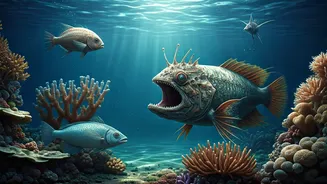
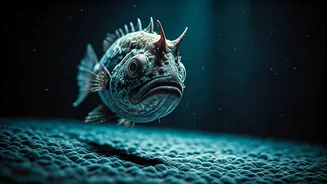
Often portrayed as a sad, gelatinous creature, the blobfish's infamous appearance is a product of its environment. In its natural habitat, nearly 4,000
feet below the surface, immense water pressure supports its flesh, giving it a typical fish-like form. Lacking a strong skeletal structure or dense muscle, its unique, jelly-like body allows it to float effortlessly, conserving energy in the extreme deep-sea conditions. The saggy, 'melted' look emerges only when brought to the surface, highlighting how profoundly external forces shape an organism's physical presentation and how our perception is often tied to its terrestrial context rather than its natural aquatic one.
Sand-Making Parrotfish
The vibrantly blue parrotfish plays a surprisingly crucial role in maintaining tropical marine ecosystems, particularly coral reefs. Armed with a beak-like mouth, these fish meticulously scrape algae from coral structures. In the process, they ingest substantial amounts of the coral's calcium carbonate skeleton. Their digestive systems then break down this material, ultimately excreting it as incredibly fine, white sand. Over a lifetime, a single parrotfish can contribute hundreds of kilograms to the sandy seafloor, meaning many of the pristine beaches we admire are, in part, a testament to this fish's culinary habits and biological processes, creating a direct link between marine life and coastal landscapes.
The Enigmatic Candiru
Dwelling in the murky waters of the Amazon River, the candiru is a small, almost transparent catfish that has earned a reputation as one of the most formidable parasites in its environment. Despite its diminutive size, it possesses a remarkable ability to locate and latch onto the gills of larger fish, where it resides as a scavenger, feeding on blood and other bodily fluids. While sensationalized tales sometimes circulate about accidental human interactions, the scientific reality underscores its highly specialized predatory adaptations for survival in a challenging, low-visibility aquatic setting. Its survival strategy is a prime example of extreme specialization within the diverse Amazonian ecosystem.
Living Fossil: Goblin Shark
The Goblin Shark is a remarkable creature, often described as a 'living fossil' due to its ancient lineage and unique appearance. It exhibits a striking pinkish hue and possesses a distinctively long, flattened snout. This specialized appendage is equipped with an electroreceptor system, enabling the shark to detect the faint electrical fields generated by potential prey in the dark ocean depths. Its most astonishing characteristic, however, lies in its highly protrusible jaws, which are not rigidly fixed to its skull. When hunting, these jaws can extend forward with astonishing speed, allowing the shark to ensnare fast-moving fish and squid, a crucial adaptation for an otherwise relatively slow swimmer navigating food-scarce environments.
The Elongated Oarfish
For generations, tales of mythical sea serpents may have been inspired by the elusive Giant Oarfish. As the longest known bony fish, reaching lengths of up to 30 feet, this ribbon-shaped creature inhabits the ocean's 'twilight zone,' a dimly lit region where sunlight penetration is minimal. Its sheer size and unusual behavior—often seen drifting vertically rather than swimming horizontally—contribute to its legendary status. The oarfish's shimmering silver skin, coupled with a prominent, flowing red dorsal fin that resembles a mane, would have easily fueled the imaginations of ancient mariners, leading them to mistake this biological marvel for a creature of myth.