







Autonomous Animal Movement
Gone are the days of early mornings and herding dogs for dairy farmers. A groundbreaking approach replaces traditional methods with a single smartphone
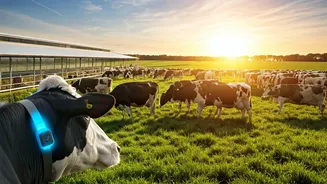
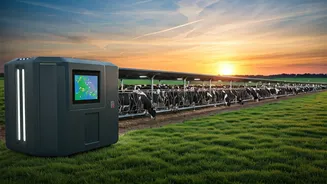
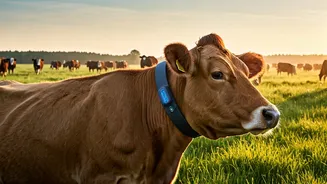
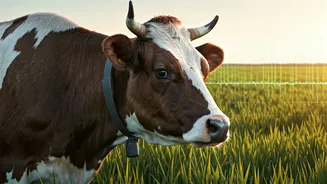
tap. This technology allows entire herds, numbering up to 600,000 animals, to autonomously navigate to milking stations. Each cow is equipped with a small device around its neck that emits a specific sound. Through learned association, the animals understand that this sound signals them to move in a particular direction. This eliminates the need for manual herding, fences, and constant human supervision, fundamentally altering the daily operations of a farm and significantly reducing labor costs and time. The efficiency gained by having the entire milking shed fill itself through automated guidance marks a significant leap forward in agricultural technology.
Virtual Fencing Unleashed
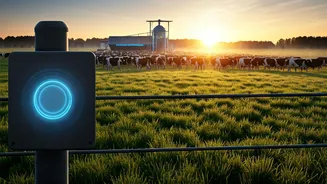
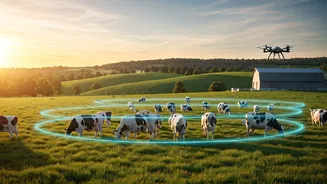
The core innovation lies in a sophisticated virtual fencing system. Farmers utilize a mobile application to draw digital boundaries on a satellite map of their land. These GPS coordinates are instantly transmitted to every cow's collar, establishing a virtual perimeter without any physical infrastructure. Each collar tracks a cow's precise location multiple times per minute. When an animal approaches the digital boundary, the collar emits a gentle sound on one side of its neck. Cows are trained to associate this sound with turning away from the boundary, effectively creating a self-sustaining containment system. This not only replaces costly and maintenance-intensive physical fences but also provides an unparalleled level of control over herd movement, allowing for precise management of grazing areas and optimal routing to essential farm facilities.
Behavioral Science at Play
The magic behind this autonomous movement isn't solely reliant on advanced technology like GPS or AI; it's deeply rooted in behavioral science, specifically operant conditioning. During an initial onboarding phase, typically lasting about a week, farmers guide cows physically while the collars emit sound cues. The crucial element is that the sound ceases the moment the cow makes the correct movement, reinforcing the desired behavior. Over time, this association becomes instinctual. After this short training period, the cows reliably respond to the sonic cues without direct human intervention. This Pavlovian trick leverages the natural social dynamics of cattle; once a few animals learn to follow the signals, the rest of the herd naturally follows, accelerating the training process and enabling collective, efficient herd movement guided by algorithms.
The 'Cowgorithm' Monitors
Beyond directing movement, the sophisticated collars continuously gather extensive data on each individual animal. This includes vital metrics such as chewing patterns, body temperature, locomotion speed, rest periods, and indicators of fertility. This wealth of information is processed by the 'Cowgorithm,' an AI trained on data from hundreds of thousands of cows. The AI develops a detailed behavioral profile for each animal, enabling it to discern normal patterns from deviations. Subtle changes in behavior, such as reduced chewing or altered gait, can be flagged as potential health issues up to 24 to 48 hours before visible symptoms manifest. Furthermore, the system precisely identifies fertility windows, which are critical and often brief, alerting farmers at optimal times to maximize breeding efficiency and improve herd reproductive health.
Economic and Growth Metrics
The impact of this technology is measurable. Users have established over 11,000 miles of virtual fencing, leading to an estimated $220 million in savings on physical fencing. The system is currently operational across more than 700,000 cattle in New Zealand, Australia, and 22 U.S. states. The company operates on a recurring revenue model, with a subscription fee of $5 to $8 per cow per month, leasing the collars rather than selling them. This subscription structure incentivizes long-term adoption, as farms become increasingly integrated into the digital infrastructure. For instance, a farm with 500 cows might incur approximately $3,000 monthly, with larger operations paying proportionally more, underscoring the scalable nature of the business model.
A Billion-Dollar Vision
This revolutionary farming technology has attracted significant investment, notably from Peter Thiel's Founders Fund, which has been involved since the company's early stages in 2018. Their continued support, culminating in a recent funding round led by Founders Fund, has valued the company at an impressive $2 billion. This substantial valuation reflects deep confidence in the technology's ability to disrupt not just agriculture but potentially other industries. The long-term investment demonstrates a belief in the platform's scalability and its potential to redefine how large numbers of living entities are managed and coordinated.
Beyond the Farm Gates
The principles behind this AI-powered system extend far beyond the realm of agriculture. At its core, the technology excels at coordinating thousands of living beings in real-time using data, sensors, and behavioral cues. The underlying architecture holds immense potential for applications in wildlife management, where remote tracking and guidance could be crucial. Similarly, it could revolutionize logistics by optimizing the movement of goods or even in advanced robotics. Fundamentally, it represents a paradigm shift in managing physical environments, enabling software systems to perform tasks that traditionally required constant human oversight and manual labor. This innovation addresses critical labor shortages in agriculture and offers a glimpse into a future where technology seamlessly integrates with and enhances natural systems.