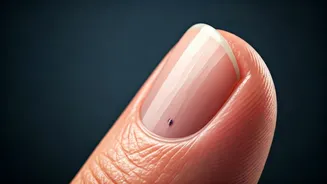







Understanding Subungual Melanoma
Subungual melanoma is an uncommon form of skin cancer that originates in the nail matrix, the area where new nail cells develop. It arises from melanocytes,
the cells responsible for pigment in both skin and nails, which start growing uncontrollably. This cancer typically presents as a dark brown or black streak beneath a nail, often widening over time. A critical sign is when the discoloration extends to the surrounding skin, known as Hutchinson’s sign. The affected nail may become brittle, split, or appear abnormal. Bleeding, discomfort, or a non-healing sore can also occur, usually affecting a single nail. While rare globally, accounting for only 0.7% to 3.5% of all melanoma cases, its implications can be severe if not diagnosed promptly. In India, it's less prevalent due to the natural UV protection offered by darker skin tones, but this rarity also leads to late detection, as early symptoms can be mistaken for fungal infections or injuries.
Subtle Symptoms Often Ignored
The primary challenge with subungual melanoma lies in its ability to mimic common nail ailments, leading people to overlook critical warnings. The most frequent indicator is a thin, dark vertical streak, which can easily be mistaken for a bruise, especially if there's a history of minor trauma to the finger or toe. It can also resemble nail fungus or pigmentation anomalies related to nutritional deficiencies, prompting individuals to self-treat or dismiss it. However, medical professionals highlight specific red flags: a band that widens, displays irregular colouring (ranging from brown to black), has fuzzy edges, or pigment that spreads onto the adjacent skin (Hutchinson’s sign). Any deformation, splitting, or unexplained damage to the nail without a clear cause for suspicion should also be investigated. Unlike a temporary bruise, these melanoma-related streaks tend to persist and evolve, making their progression a key differentiator. While harmless pigmentation changes are common, particularly in darker skin tones, a single dark streak that shows signs of widening, changing shape, or altering in colour warrants immediate medical evaluation.
Reasons for Delayed Diagnosis
Despite being outwardly visible, subungual melanoma frequently suffers from delayed diagnosis due to a combination of anatomical, awareness, and diagnostic factors. Its location beneath the nail makes it less conspicuous than skin lesions on exposed body parts, and many individuals do not regularly scrutinize their nails for changes. Furthermore, public awareness about this specific type of cancer is considerably lower compared to more common cancers, leading people to underestimate the significance of unusual nail discolouration. Clinicians can also face challenges, sometimes misidentifying early-stage subungual melanoma as more common nail disorders, thereby delaying appropriate diagnostic tests and treatment. Early detection is paramount, as melanoma, if caught in its initial stages, typically has a high survival rate, often exceeding 90-95%. However, a delayed diagnosis can allow the cancer to spread to other organs, significantly complicating treatment and worsening outcomes, potentially making it life-threatening. Timely and accurate diagnosis is therefore crucial, as treatment effectiveness is directly linked to the stage at which the cancer is identified.
Skin Cancers in India
Skin cancer is less prevalent in India than in Western countries but remains a significant health concern, accounting for approximately 1-3% of all cancer cases nationwide, with over 1.5 million new cases reported annually. Basal cell carcinoma (BCC) is the most common type, particularly in sun-exposed rural areas, growing slowly and rarely spreading. Squamous cell carcinoma (SCC) is more aggressive and can metastasize if untreated, often linked to prolonged sun exposure or chronic wounds. Melanoma, while less common, is the most dangerous due to its rapid spread. Importantly, melanoma can develop in areas with minimal sun exposure, such as the palms, soles, and crucially, under the nails. There's emerging evidence suggesting subungual melanoma might be more prevalent in individuals with darker skin tones than previously believed, a factor that could contribute to underdiagnosis in India, where awareness of specific cancer symptoms is still developing. Cultural tendencies to dismiss minor physical changes unless painful or disruptive, coupled with a delayed approach to seeking medical help until a condition becomes severe, further complicate early detection efforts, although a growing interest in preventive healthcare in urban areas offers a chance to enhance awareness of less common warning signs, including those affecting the nails.
When to Seek Help
While not every nail streak warrants immediate alarm, certain patterns and accompanying symptoms strongly suggest the need for professional medical evaluation. A line that appears spontaneously without any identifiable injury, shows continuous growth, or undergoes changes in its colour demands attention from a doctor. Any concurrent issues like persistent pain, bleeding from the nail area, or noticeable nail deformation should also prompt further investigation. Dermatologists often refer to the ABCDE rule for melanoma detection on the skin: Asymmetry, irregular Borders, Color variation, increasing Diameter, and Evolution (changes over time). If any skin lesion exhibits these characteristics or if a new, unusual growth emerges, consulting a doctor is advisable. For nail concerns, a streak that progressively widens, darkens, or alters its shape, or pigment that spreads to the surrounding skin, should be seen as potential red flags. Early consultation is critical, as a timely diagnosis, often involving a clinical examination and potentially a biopsy, significantly improves treatment outcomes and survival rates.