



Ancient Tech, Astonishing Reach
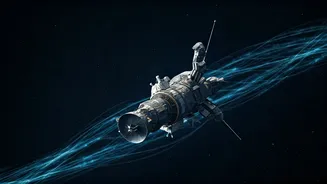
Launched in 1977, NASA's twin Voyager spacecraft are true marvels of engineering, continuing their interstellar journey decades later. Their onboard computers,
a far cry from today's smartphones, operate on assembly language code painstakingly crafted nearly fifty years ago. Each probe possesses a mere 64 to 70 kilobytes of memory across its three computer systems, a storage capacity smaller than a single low-resolution image on a modern device. Managing these primitive systems is likened by NASA's Suzy Dodd to operating an early Apple II computer, highlighting the stark contrast between the Voyager's technological era and the present day. This longevity is a testament to the robust design and the persistent efforts of a dedicated team.
Code That Connects Worlds
The operational language of the Voyager spacecraft is often misrepresented. While sometimes mistakenly referred to as Fortran, the critical flight operations rely on a much lower-level language: assembly code. This assembly programming is designed for highly specialized hardware, conceived in the early 1970s, and is fundamental to the spacecraft's core functions. Fortran, on the other hand, is associated with ground-based systems and older mission support tools, not the actual software guiding the probes through space. The complexity of maintaining this system is underscored by job postings for replacement engineers, which require not only assembly language proficiency but also an intimate understanding of the spacecraft's unique hardware architecture, a combination that is increasingly rare.
Fading Expertise, Enduring Mission
The Voyager mission's continued operation faces a significant challenge: the disappearance of the engineers who originally built and programmed it. Forty-nine years of continuous operation have created knowledge gaps that extend far beyond programming languages. After Voyager 2's Neptune flyby in 1989, the flight software was updated to enhance autonomy. This augmented version, further supported by periodic command sequence uploads from Earth, forms the basis of the current operational system. However, the team responsible has aged considerably, and much of the original paper documentation has been lost or fragmented. The last original Voyager engineer retired in 2016 at the age of 80, leaving a critical void. This diminishing institutional memory means that the knowledge required to truly understand and repair the spacecraft is becoming a relic, mirroring the eventual depletion of the plutonium power sources that sustain the probes.
The Long Signal Home
The vast distances the Voyager spacecraft now traverse mean that their signals take an incredible amount of time to reach Earth. A status check from Voyager can take over 23 hours to arrive. By the time NASA receives this vital data, the spacecraft will have already journeyed an additional 1.5 million kilometers deeper into interstellar space. This immense separation underscores the autonomy of the probes and the increasing difficulty of communication. As each year passes, more of the critical, hands-on knowledge required to manage these pioneering spacecraft vanishes with the original engineers. The eventual retirement or passing of the last individual who understands the assembly code will leave NASA with only fragmented documentation, a weakening signal, and a complex, interstellar machine that no living person can fully comprehend or repair.