





Human Eyes on Moon
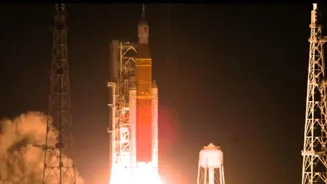
Artemis 2's primary objective is to test the Space Launch System rocket and Orion spacecraft, preparing for future crewed missions. However, the nearly
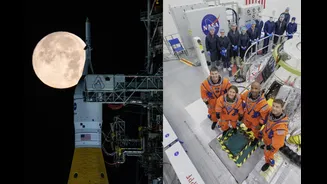
10-day journey offers a unique chance for scientific discovery, particularly during the five-day mark when Orion will orbit the moon at a close distance of several thousand kilometers. While science isn't the main driver for this specific mission, it's being leveraged as an invaluable opportunity to gather data for subsequent Artemis endeavors where science will take center stage. The astronauts will act as sophisticated biological sensors, observing the moon with their unaided vision and using handheld cameras to document their findings. These observations will be supplemented by verbal descriptions and annotations on tablets, providing nuanced insights that even advanced orbital spacecraft can't replicate. This direct human perspective allows for a holistic view of the lunar disk, including regions of the far side that have never been seen directly by humans, enabling immediate contextualization of observations across different lunar terrains.
Preparing for Lunar Surface
The hands-on experience gained during Artemis 2's lunar flyby is crucial for preparing astronauts for future surface missions. While specific crews for later Artemis expeditions are yet to be chosen, the astronauts are already undergoing extensive training, including a week-long 'Lunar Fundamentals' course and practical fieldwork. Initially, the Artemis 2 crew expressed some skepticism about the scientific value of their observations, questioning what insights they could provide that orbiting spacecraft couldn't. However, the science team successfully conveyed the significant weight their verbal descriptions and visual documentation would carry, emphasizing how these observations could help unravel high-priority lunar mysteries. Astronauts like Victor Glover, the mission pilot, have expressed excitement about using their unique human perspective to observe the moon and cosmic phenomena up close, recalling how Apollo 17 geologist Jack Schmitt noted color variations in lunar minerals visible only from a distance of approximately 5,000 kilometers, a detail Artemis 2 aims to recapture.
Eclipse & Beyond
The Artemis 2 mission presents an unexpected bonus scientific opportunity: the potential for a solar eclipse. If the mission launches within the early part of the April 1 window, Orion's trajectory could align perfectly for the moon to momentarily obscure the sun from the spacecraft's viewpoint. Mission specialists like Jeremy Hansen are thrilled about this serendipitous event, with the science team rapidly developing instructions for the astronauts on how to leverage this rare phenomenon for lunar observation. Furthermore, the mission extends its scientific reach beyond lunar imaging. Aboard Orion will be the AVATAR experiment, which will host 'organs on a chip' to study the effects of radiation and microgravity on bone marrow tissue samples from the Artemis 2 crew. The astronauts will also wear monitors to track their movement and sleep patterns, alongside studies of their immune systems. Radiation monitors, similar to those used on Artemis 1, will be provided by the German space agency DLR, underscoring the mission's commitment to integrating cutting-edge technology into every available opportunity, as highlighted by Nicky Fox, NASA associate administrator for science. The crew has fully embraced these experiments, with Victor Glover remarking that it feels like having "extra four crewmembers."