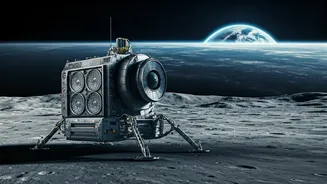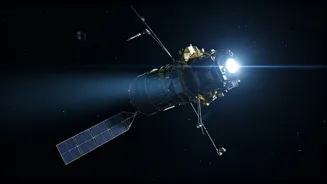







Voyager 1's Enduring Mission
Launched in 1977, the Voyager 1 spacecraft has become humanity's most distant emissary, venturing far beyond its initial planetary exploration goals. Now,
traversing the vast expanse of interstellar space, it continues to provide invaluable data about conditions beyond our solar system's influence. Its sister craft, Voyager 2, works in tandem, making them the sole sources of direct information from this uncharted territory. The mission's longevity is a testament to pioneering engineering, but the realities of operating in such an extreme environment, with limited power reserves, necessitate difficult choices to maintain its operational status. This ongoing mission allows scientists to gain unprecedented insights into the heliosphere and the true nature of the space between stars.
Power Constraints Drive Decisions
The primary driver behind powering down one of Voyager 1's instruments is a critical shortage of electrical power. The spacecraft relies on a radioisotope thermoelectric generator (RTG) that converts heat from decaying plutonium into electricity. Over its nearly five decades of operation, this power source has gradually diminished, with approximately 4 watts of energy lost annually. Without proactive measures, the spacecraft risks encountering an automatic fault protection system, which could disable multiple essential components simultaneously, making a recovery process exceedingly complex and potentially impossible. This deliberate shutdown is a calculated step to prevent such a catastrophic failure and prolong the mission's scientific output.
Instrument's Long Service Ends
The specific instrument deactivated is the Low-Energy Charged Particles Experiment (LECP), which has been a consistent performer since Voyager 1's inception in 1977. For almost half a century, the LECP diligently studied ions, electrons, and cosmic rays originating from both within the solar system and from interstellar sources. Its data has been instrumental in enhancing our understanding of the region beyond the heliosphere, including the detection of pressure waves and fluctuations in particle density. Despite its significant contributions, the need to preserve the mission's overall operational capacity made its deactivation a necessary sacrifice, as stated by Voyager mission manager Kareem Badaruddin. Two other science instruments remain active, focusing on plasma waves and magnetic fields.
A Strategic, Gradual Shutdown
The deactivation of the LECP was not an impulsive decision but rather a carefully orchestrated phase within a long-term strategy designed to manage Voyager 1's declining power. Engineers had anticipated this need and developed a plan to systematically power down instruments as energy reserves dwindled. Initially, each Voyager spacecraft was equipped with ten instruments, but many have already been decommissioned over time. The LECP was the next in line for this process, with a similar procedure scheduled for Voyager 2 in 2025. The immense distance of Voyager 1, now over 15 billion miles from Earth, presents significant communication challenges; commands can take up to 23 hours to reach the spacecraft, adding further complexity to the shutdown process.
Mission Continues, Future Hope
Even with the deactivation of the LECP, Voyager 1's mission is far from over. It continues to transmit vital scientific data from interstellar space, thanks to its two remaining operational instruments that monitor plasma waves and magnetic fields. Interestingly, a small, low-power component of the LECP has been intentionally left active. This preserves the possibility of reactivating the instrument in the future should sufficient power become available. Furthermore, engineers are developing an innovative strategy, dubbed the "Big Bang," to enhance the spacecraft's longevity. This plan involves replacing power-intensive components with more energy-efficient alternatives. Initially to be tested on Voyager 2, this approach, if successful, could significantly extend Voyager 1's operational life, potentially by at least another year and even opening avenues for future system revival.