



Nature's Guiding Instinct
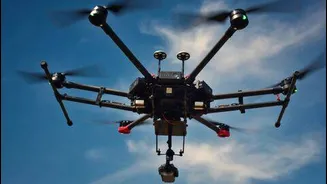
The challenge of making very small autonomous drones capable of independent navigation is significant, primarily due to the limited space for sophisticated
equipment. To overcome this, researchers have developed an innovative system called Bee-Nav, drawing inspiration from the remarkable navigational skills of honeybees. As described in a recent publication, bees employ a two-pronged approach to find their way. Initially, upon leaving their hive, they undertake a brief exploratory flight to imprint memorable visual cues of their surroundings. During their journeys, bees meticulously track their direction and velocity, a process known as path integration. While path integration is effective, it's susceptible to minor cumulative errors over distance. Therefore, bees rely on their stored visual memories of landmarks to make crucial course corrections as they approach their home, ensuring accurate returns. This elegant natural system forms the foundation for the new drone technology.
Mimicking the Buzz
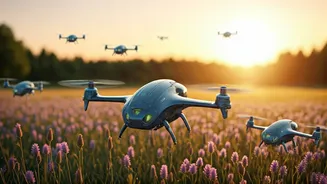
Scientists have successfully emulated the bee's sophisticated navigation strategy for miniature autonomous drones. The Bee-Nav system begins with a drone performing a 'learning flight' around its starting point, much like a bee memorizing its environment. During this phase, a compact, omnidirectional camera captures the surrounding visual landscape. This visual data is then fed into a tiny onboard neural network, which is trained to associate specific images with 'home vectors'—essentially invisible directional pointers leading back to the launch site. This process establishes a 'Learned Homing Area,' a designated safe zone. Once this initial training is complete, the drone can be dispatched on missions away from its base. It initially relies on path integration, using its recorded speed and direction to retrace its steps. If the drone finds itself within the pre-established safe zone, the trained visual neural network takes over, guiding it the remainder of the way back to its origin with precision.
Compact Powerhouse
A key breakthrough of the Bee-Nav system is its remarkable efficiency, utilizing minimal computational resources. The entire navigation system operates on an off-the-shelf Raspberry Pi 4 computer, a device comparable in size to a credit card. This compact computer runs sophisticated neural networks that require between 3.4 and 42.3 kilobytes of memory—a fraction of the storage capacity used by conventional mapping and navigation systems, often thousands of times less. This low-power, compact design is crucial for miniaturized drones. In outdoor tests, the drones equipped with Bee-Nav successfully navigated back from distances of up to 600 meters (1,970 feet), even when faced with challenging conditions like strong wind gusts and direct sunlight that could obscure camera vision. This efficiency has garnered significant attention from experts in robotics, who highlight its potential for enabling practical outdoor deployments of small-scale robots.
Future Flight Horizons
While the Bee-Nav system represents a significant advancement, the research team is actively addressing remaining challenges to further enhance its capabilities. Future developments aim to enable navigation between multiple memorized locations, moving beyond just returning to a single home base. Additionally, researchers are working on solutions for scenarios where initial landmark-free starting points are encountered. For cluttered or dynamic environments, platforms running Bee-Nav will require integrated obstacle avoidance and path planning functionalities to ensure safe and efficient operation. Despite these ongoing efforts, the current Bee-Nav technology already allows for the creation of smaller and more energy-efficient autonomous drones, potentially deployable on drones as light as 50 grams, or even 30 grams. The ultimate goal is to equip drones the size of actual bees, which will necessitate solving fundamental issues like battery miniaturization, but the intelligence framework for such future systems is being developed now.