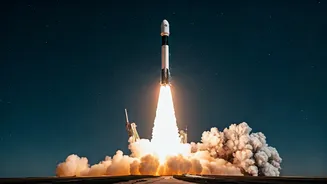








Rocket's Core Design
The Falcon 9, designed and manufactured by SpaceX, is a partially reusable two-stage-to-orbit medium-lift launch vehicle. This simply means the rocket
can carry payloads into space and some of its components are made to be reused. The first stage is powered by nine Merlin 1D engines. These engines, arranged in an octagonal pattern, provide the initial thrust needed to lift the rocket off the launchpad. The second stage has a single Merlin 1D Vacuum engine, optimized for operation in the vacuum of space, which continues the journey after the first stage separates. The Falcon 9 is designed for reliability and efficiency, aiming to reduce the cost of space access. It has a height of 70 meters (230 ft) and a diameter of 3.7 meters (12 ft), making it a significant presence on the launchpad. The rocket’s design facilitates both crew and cargo transport, highlighting its versatility in various space missions. The rocket's structure utilizes a combination of advanced materials, making it strong yet relatively light. This allows for optimal performance and payload capacity. The reusable aspects, particularly the first stage, contribute significantly to cost reduction. The meticulous engineering behind the Merlin engines enables high-performance capabilities, crucial for challenging missions. Moreover, the design features of the Falcon 9 provide opportunities for continuous upgrades and improvements.
Pre-Launch Preparations
Before the Falcon 9 can take flight, extensive preparations are undertaken. This process begins weeks before launch, including rigorous testing of all rocket systems, checking for any potential issues. The payload, whether it's satellites, cargo, or crew, undergoes similar checks to ensure it’s ready for the mission. The launch site undergoes inspections to verify weather conditions and range safety. The rocket itself is transported to the launch pad, where it's erected and prepared for fueling. The fueling process involves loading the rocket with liquid oxygen and RP-1 propellant, a highly refined form of kerosene. This is a delicate and time-sensitive procedure, performed shortly before liftoff. Teams of engineers and technicians work around the clock during this phase, addressing any unforeseen challenges. Communication systems are tested to ensure that ground control can maintain contact with the rocket. The mission's flight path and trajectory are meticulously planned, taking into account orbital mechanics and the desired destination. As the launch time approaches, final checks and confirmations are performed. Countdown sequences are initiated, with any last-minute adjustments. This ensures that the launch process unfolds smoothly and successfully.
Mission Objectives
The Falcon 9 rocket undertakes a diverse range of missions. These include deploying satellites into various orbits for various purposes like communications, Earth observation, and scientific research. It also transports cargo and crew to the International Space Station (ISS), supporting the station's operations and facilitating scientific experiments. Furthermore, the Falcon 9 plays a key role in lunar and deep-space missions. In the commercial sphere, Falcon 9 provides reliable access to space for various customers, including government agencies and private companies. Each mission has specific objectives that dictate its flight profile, payload deployment, and duration. For example, some missions require precise orbital insertion of a satellite, while others involve docking with the ISS. The Falcon 9's versatility and performance make it suitable for a wide variety of tasks. The flexibility of the Falcon 9 means SpaceX can accommodate a diverse customer base. Falcon 9’s consistent success supports the advancement of scientific exploration and commercial space endeavors.
Post-Launch Activities
After the Falcon 9 has completed its primary mission, several crucial activities occur. These activities include the separation of stages, and the controlled landing of the first stage. This reuse of the first stage is a defining characteristic of SpaceX's business model. First-stage landings can happen on a landing pad on land or a drone ship at sea, with precise navigational guidance. The second stage continues its journey into space to deploy the payload or begin its mission. Upon reaching its destination, the payload is released into the intended orbit or trajectory. Post-mission, ground crews analyze data, assess performance, and prepare for the next launch. The recovery process involves retrieving the landed first stage, inspecting its condition, and refurbishing components for future flights. All collected data supports improving future launches and designs. The entire process, from launch to recovery, is meticulously tracked and documented. These improvements are instrumental in driving down the cost of space access and increasing the frequency of launches.
Impact of Falcon 9
The Falcon 9 has transformed the space industry. It has made space travel more accessible and affordable, leading to the growth of the commercial space sector. The reusable nature of its first stage has significantly reduced launch costs, spurring innovation and competition. By offering reliable and cost-effective launch services, SpaceX has enabled governments, private companies, and research institutions to send more satellites and payloads into space. This has, in turn, fueled advancements in fields like telecommunications, Earth observation, and scientific research. The Falcon 9 has increased the frequency of launches and has allowed access to space for a wider range of customers. It has also boosted the growth of related industries, creating new job opportunities and promoting technology development. The success of the Falcon 9 serves as a proof of concept. The constant advancements of the Falcon 9 provide inspiration for future space exploration.