



Pioneering Space Computing
The future of artificial intelligence is reaching for the stars, as India prepares to host its inaugural large language model (LLM) training conducted
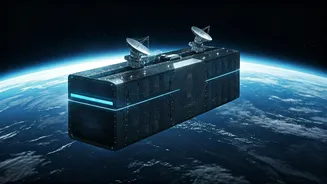
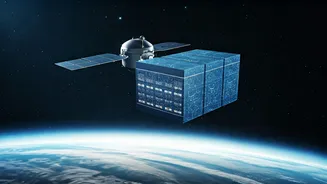
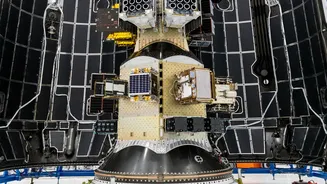
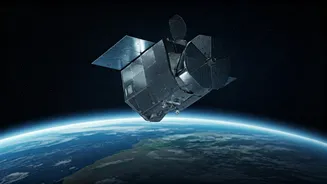
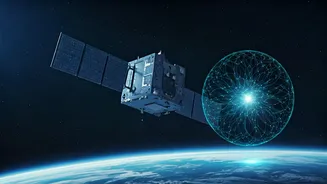
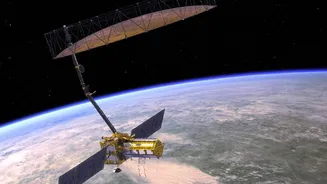
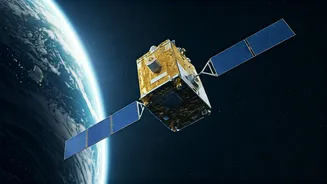
entirely in orbit. This ambitious endeavor is spearheaded by a partnership between space-tech firm Pixxel and LLM provider Sarvam AI. Their joint project involves the development of "The Pathfinder," a novel orbital data center satellite projected to be operational by the close of 2026. This 200-kilogram satellite will be equipped with powerful Graphics Processing Units (GPUs), mirroring the capabilities of terrestrial data centers, enabling the sophisticated training and inference processes required for advanced AI models. Unlike conventional space computing, which often employs less powerful processors for resilience, Pathfinder is designed for high performance, marking a significant leap in extraterrestrial computational capacity. This move aligns with a global trend of tech giants and startups looking to space to overcome Earth's growing energy constraints and data processing demands, an estimated 200 GW global data center capacity by 2030, with India aiming for a substantial 10.5 GW by 2031.
The Pathfinder Mission Details
Pixxel is set to undertake the comprehensive design, construction, launch, and operational management of the Pathfinder satellite, which will be developed at their forthcoming Gigapixxel facility, designed for scalable satellite production. While specific technical specifications remain under wraps, the collaboration ensures that Sarvam AI will directly handle the training and inference of its language models in the unique environment of orbit. This allows for processing data without reliance on external cloud or ground infrastructure, fostering a truly sovereign AI capability. The mission is designed to rigorously test and validate real-time AI inference and data processing within the challenging conditions of space. Key performance indicators will include power management, thermal regulation, and the efficiency of real-time data workflows, laying critical groundwork for future orbital data center systems and assessing their technical and commercial viability. The initiative also incorporates a hyperspectral imaging camera to capture high-fidelity data, which will then be analyzed in orbit by AI models trained in space, reducing data transmission needs and enabling faster insights.
Benefits of Orbital AI
The development of orbital data centers like Pathfinder represents a new frontier in computing, offering distinct advantages over terrestrial solutions. By positioning compute power in space, systems can harness abundant solar energy and operate closer to space-based data sources, circumventing some of the limitations faced on Earth. This approach is crucial for shaping the future of space infrastructure. For Sarvam AI, this partnership signifies an extension of India's full-stack AI platform into orbit, enabling the creation of indigenous AI models operating on an Indian-built satellite. This level of control over intelligence infrastructure is paramount for national technological sovereignty. Furthermore, the ability to process large volumes of raw imagery directly in orbit, identifying patterns and generating insights in real time, dramatically shortens the time between data capture and actionable decision-making. This accelerates responses in critical areas such as environmental monitoring, resource management, and infrastructure tracking, a significant improvement over traditional methods that require extensive data transfer and ground-based processing.
Challenges and Future Outlook
Despite the promising potential, the concept of orbital data centers is not without its challenges. Many experts have voiced concerns about the commercial viability, citing the high cost of rocket launches, which would need to decrease significantly from current figures to be economical. Beyond launch expenses, the operational costs of maintaining a data center in space, including the complex task of servicing or replacing failing space-based GPUs during critical AI model training, present significant hurdles. Nonetheless, the trajectory of space-based computing is gaining momentum, with initiatives like this from Pixxel and Sarvam AI pushing the boundaries of what's possible. Even national space agencies like ISRO are actively exploring next-generation satellites with integrated on-board data processing and storage capabilities. The Pathfinder mission, by addressing both the technical feasibility and exploring the operational nuances of space-based AI, aims to prove the concept and establish the foundational technical and commercial framework for a new era of orbital computing.