






The Challenge of Sugarcane Health
Sugarcane, a vital global crop, faces significant threats from diseases that are notoriously difficult to detect due to its dense and tall growth structure.
Infections often begin deep within fields, evading manual inspection and conventional aerial surveys. This makes early intervention a major hurdle for farmers, leading to potential widespread crop loss and impacting food security. Moreover, changing climatic conditions are exacerbating this problem by accelerating the life cycles of pathogens and broadening the geographical reach of agricultural pests. The traditional methods of monitoring crop health are proving inadequate against these evolving challenges. Traditional methods rely heavily on visual inspection, which is time-consuming, labor-intensive, and often misses the subtle early signs of disease that manifest in the plant's interior. The sheer scale of sugarcane cultivation amplifies these limitations, making it almost impossible to check every single plant individually. This gap in detection allows diseases to spread unchecked, leading to substantial economic losses for farmers and contributing to broader concerns about agricultural sustainability and global food supplies. The need for a more advanced, efficient, and precise detection system is therefore paramount in ensuring the health and productivity of sugarcane farms worldwide.
Introducing the AI Butterfly Bot
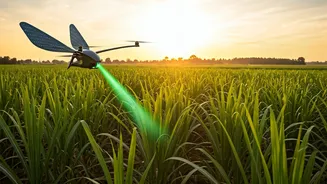
Researchers have engineered a unique, butterfly-inspired AI-powered flying robot to tackle the pervasive issue of sugarcane crop disease. This innovative device is capable of navigating through dense sugarcane stalks, capturing high-resolution images of individual leaves, and employing artificial intelligence to identify various common ailments. What sets this robot apart is its integrated GPS tagging system, which accurately marks the precise locations of infected plants, providing farmers with actionable data. Diseases such as red rot, smut, wilt, and ratoon stunting can now be detected significantly earlier than through traditional, less precise methods. The design, inspired by natural flight patterns of butterflies and birds, optimizes cost-effectiveness, flight stability, and field coverage. This technological advancement represents a significant stride towards proactive crop management. The robot's ability to get up close to the plants allows for a level of detail that overhead drones simply cannot achieve, ensuring that even subtle signs of infection are not missed. This meticulous approach to data collection, combined with sophisticated AI analysis, empowers farmers with unprecedented insights into their fields' health, paving the way for more effective disease control strategies and healthier crop yields.
Precision Farming Through Digital Maps
The data collected by the AI butterfly bot is seamlessly integrated into a sophisticated web and mobile platform, creating a dynamic, live digital map of the entire field. This digital representation allows farmers to visualize disease 'heat maps,' illustrating areas with higher concentrations of infected plants. By analyzing trends and receiving real-time alerts, farmers can move away from broad, indiscriminate treatments and instead implement highly targeted interventions. This precision approach not only conserves resources but also significantly reduces the environmental impact associated with the overuse of agrochemicals, preventing harmful runoff into soil and water systems. The benefits extend to consumers as well, through the availability of healthier crops and potentially lower food costs. This system transforms how farmers approach disease management, shifting from reactive measures to proactive, data-driven strategies. The ability to see exactly where problems lie means that treatments can be applied only where and when necessary, leading to greater efficiency and sustainability in agricultural operations. This digital mapping technology is a crucial component of modern precision agriculture.
Future Applications and Commercialization
The researchers have not only developed this groundbreaking technology but have also taken steps towards its widespread adoption by filing a patent for their invention, supported by initiatives aimed at fostering rural entrepreneurship. While initially conceptualized as a ground vehicle, its evolution into a lightweight, flying robot underscores a commitment to practical and cost-effective design. Beyond individual farm applications, this AI-powered device holds considerable potential for broader industry impact. Agritech companies could leverage this technology to offer comprehensive crop monitoring services. Furthermore, large-scale operations such as sugar mills and research institutions could utilize the collected data for more accurate yield forecasting and improved supply chain planning, optimizing the entire agricultural ecosystem. With successful real-world testing completed and the patent pending, the technology is poised for commercial deployment in the coming years, contingent on securing adequate support. This innovation signifies a major advancement in agricultural technology, with the potential to significantly improve crop yields, reduce waste, and enhance the overall efficiency of sugarcane production globally.