
Black Holes Unleashed
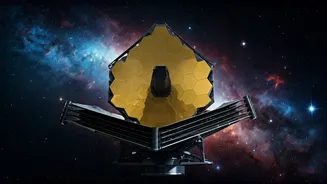
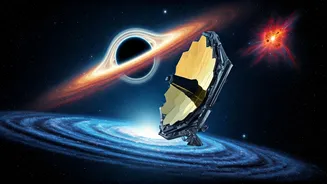
The James Webb Space Telescope (JWST) has been instrumental in unveiling the hidden realms of black holes and their intricate interplay with galaxies.
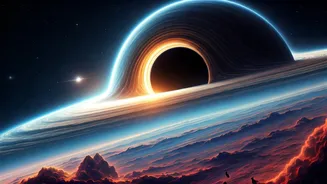
One remarkable discovery involved a supermassive black hole, dubbed 'BiRD', devouring a galaxy named Pablo's Galaxy. Scientists observed this event, which helped them understand the destructive power of black holes. Furthermore, the JWST captured a runaway supermassive black hole speeding through its galaxy at an astounding 2.2 million mph. This runaway behavior is providing insight into black hole interactions within galaxies. These findings are revolutionary, opening up new avenues for exploring the universe and its phenomena.
Early Universe Wonders
The JWST is giving us a unique view of the early universe, allowing us to observe events that occurred billions of years ago. The telescope detected the first evidence of 'dinosaur-like' stars, an unexpected discovery offering hints about the universe's initial stellar composition. Also, the JWST captured a rapidly feeding supermassive black hole in the infant universe, a finding considered remarkable. These discoveries enhance our understanding of how stars and galaxies formed. In addition, the telescope spotted a gassy baby galaxy throwing a tantrum, giving scientists a new angle on the turbulent processes of galactic evolution. These observations allow us to see what our universe looked like a long time ago.
Cosmic Objects Uncovered
Beyond black holes and galaxies, the JWST is revealing other unusual celestial objects. The telescope observed mysterious 'little red dots,' potentially black holes in disguise. Another intriguing find was a 'super-puff' exoplanet, which JWST observed as it was losing its atmosphere. Additionally, the telescope uncovered a one-of-a-kind triple-star system resembling a cosmic embryo. These findings are helping astronomers understand the diversity and evolution of cosmic entities. Furthermore, the telescope observed a supernova explosion, which may have led to the creation of a binary black hole. These studies contribute to the continuous refinement of the universe's image.
Observing the Milky Way
The JWST also plays a critical role in studying our own galaxy, the Milky Way. It has been used to study the activities of the supermassive black hole residing at the galaxy's center. The data from the JWST revealed a violent history, which included the black hole firing out flares. Another study involved the 'sharpest view ever seen' of a black hole's dusty disk. Observations of this kind give important insights into the processes which affect the dynamics and the behavior of the center of the galaxy. Using the JWST's data, scientists are now able to comprehend the dynamics of our galaxy, including the structure of the black holes in the center.
Hubble's Observations Too
While the James Webb Space Telescope has been making breakthroughs, the Hubble Telescope continues to contribute valuable data. Hubble captured a star blasting out a jet of hot gas 32 light-years long, a dynamic event that reveals stellar processes. In addition, the Hubble spotted a glowing bridge that connects dwarf galaxies. Hubble's observations of the Ring Nebula revealed an enormous iron bar, which left astronomers puzzled. Although it is aging, Hubble still helps scientists understand the cosmos' complexity by offering a unique viewpoint on stellar objects and galactic phenomena. These joint studies advance our comprehension of the cosmos.
Other Exciting Discoveries
Beyond the JWST and Hubble, other instruments are also enhancing our understanding. NASA's X-ray instruments found that black holes act like 'cosmic seesaws', influencing the shape of the universe. In addition, an X-ray spacecraft revealed the violent history of the Milky Way's supermassive black hole. The astronomical community is excited by these new advances, which provide new insights into the history of the universe and the behavior of celestial objects. These advancements make for ongoing and exciting research, helping to address the numerous questions about the nature of space.