






Laser Link Established
A pivotal moment in satellite communication has been reached as a technology firm based in Singapore successfully conducted trials for transmitting laser
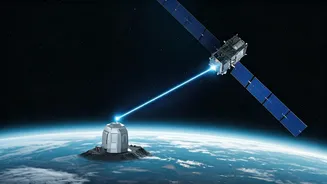
signals from an orbiting satellite down to terrestrial receivers. This groundbreaking experiment involved two ground stations, situated in Singapore and Spain, which were equipped to detect and meticulously track the laser beams broadcast from a satellite launched last year. This achievement represents the final hurdle before the company can move on to transmitting actual data, a crucial step for revolutionizing how information travels between space and Earth. The ability to reliably establish and maintain this connection is paramount, especially considering environmental factors like atmospheric disturbances and urban light pollution that can interfere with laser signals. The company's innovative approach involves employing specialized optical filters on ground-based telescopes, precisely tuned to the laser's unique frequency, thereby minimizing interference from ambient light. Furthermore, distinct, pulsating patterns are utilized to ensure the satellite's laser signal is clearly identifiable against the myriad of other light sources in the night sky. This sophisticated method ensures that even amidst challenging conditions, the laser signal remains distinct and detectable, setting the stage for high-volume data transmission.
Tracking the Beam
With the successful detection of the laser signals, the next critical phase involves sophisticated tracking mechanisms to maintain a continuous connection as the satellite traverses the sky. Advanced computer vision algorithms are employed, enabling the ground stations to lock onto the laser transmission and follow its path with remarkable precision. This closed-loop tracking system is essential for ensuring an unbroken data stream, compensating for the satellite's movement and any atmospheric jitter. Once this precise tracking capability is established, the company is set to move forward with its ambitious plans to test and demonstrate high-speed data transmission from its satellite to the ground stations. Beyond the current test locations, the company is actively working to expand its ground infrastructure, with plans to establish new optical ground stations in strategically important locations, including near Austin, Texas, and in Australia. This expansion is vital for creating a robust network capable of supporting global communication needs and facilitating wider adoption of space-to-ground laser technology, ultimately enhancing connectivity and data transfer capabilities for various applications.
Evolving Communication
This company's journey into space-based optical communications is a significant evolution from its origins in terrestrial systems. While previously focused on ground-based laser networks, the firm has pivoted to leverage its expertise for orbital applications. They are currently supplying specialized terminals to multiple satellite manufacturers, initially for inter-satellite links – a common application for optical communication in space. However, their technology is equally adept at facilitating space-to-ground communication. The company also has a visionary plan to deploy its own constellation of data-relay satellites, all equipped with advanced optical communication capabilities. This strategic move indicates a strong belief in the future potential of laser-based communication for a wide range of services. The company's progress is further underscored by recent collaborations, including an agreement to demonstrate optical communication for an intelligence, surveillance, and reconnaissance satellite constellation set to launch in the fourth quarter. This partnership highlights the growing demand and versatility of laser communication technology across different sectors.
Market Demand Soars
The demand for satellite-based optical communication terminals is experiencing an unprecedented surge, with the company reporting that interest is outstripping current supply capabilities. This high demand is a clear indicator of the industry's rapid shift towards laser-based communication solutions. The company has successfully secured agreements with five satellite developers in just the past five months, signaling strong market confidence in their offerings. Concerns about the future availability of these crucial components have been amplified by recent industry acquisitions. Despite these market dynamics, the company is well-positioned due to its innovative terminal design, which is reportedly one-fourth the size of competing solutions and also more cost-effective. This competitive advantage is attracting a growing customer base, particularly for space-to-ground optical communication applications. The increased interest in this technology was notably observed following the Artemis 2 mission, where NASA successfully demonstrated high-data-rate optical communication, returning imagery and video from the Orion spacecraft at speeds far exceeding traditional radio-frequency links. This successful demonstration has undoubtedly heightened awareness and spurred further development in the field.