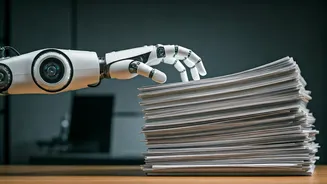

AI's Rise and Jobs
Goldman Sachs' recent assessment points towards a future where Artificial Intelligence (AI) will significantly alter the employment landscape, leading
to a substantial number of job cuts. The prediction highlights that AI, particularly in automation, is poised to take over roles traditionally held by humans. The firm's analysis indicates that the implementation of AI across diverse industries is likely to result in a reduction in the workforce. This trend is not new, but the pace and scale of this transformation are what make this forecast particularly noteworthy. The integration of AI into operations is becoming more sophisticated, allowing machines to perform tasks that were previously exclusive to human workers. The impact of this automation will vary across sectors, with some experiencing more significant job displacement than others. The central message from Goldman Sachs is a call for businesses and employees to prepare for a changing job market. This preparation might include retraining, upskilling, and adapting to new work models that incorporate AI technology.
Layoffs Looming in 2026
Goldman Sachs' projection concerning layoffs, expected to begin in 2026, serves as a critical warning for companies and individuals. The firm's forecasts suggest that the proliferation of AI tools and automated systems will lead to redundancies across various sectors. While technological advancements have always led to changes in employment, the speed and breadth of AI integration are unprecedented. The expectation is that AI will be capable of handling more complex tasks, thus requiring fewer human workers. This shift will likely affect several job roles. Goldman Sachs' warning is not simply a doomsday scenario, but a call to acknowledge and strategically address the challenges ahead. The emphasis is on proactive measures, such as workforce restructuring, employee reskilling, and the creation of new job roles that complement AI systems. The ability to adapt to a changing job market will be crucial for both companies and employees. Therefore, investing in relevant skills and being ready to adopt innovative work strategies will be essential.
Why AI Drives Change
The underlying reason for the expected layoffs centers on the increasing capabilities of AI, especially in automating routine and repetitive tasks. AI algorithms can perform tasks, from data analysis to customer service, that once required human intervention. This automation enhances efficiency and reduces operational costs for businesses. As AI technologies advance, their ability to take on more complex and nuanced tasks also increases. This growth will contribute to greater job displacement. Additionally, the adoption of AI is not just about replacing human labor; it is also about improving accuracy and speed. AI-driven systems rarely make mistakes and can process information at a pace humans can't match. This efficiency makes them a compelling option for many companies. However, this shift in the way businesses operate means that the demand for workers with specific skills might decline. The primary driver of this is the increasing automation of processes across various industries, making some traditional roles obsolete.
Industries at Risk
Although the impact of AI will be felt across the board, certain industries are particularly vulnerable to job losses. Goldman Sachs' analysis likely considers which sectors are most ripe for automation. Sectors like data entry, customer service, and manufacturing are predicted to experience considerable changes, since AI can handle many of the tasks traditionally done by humans. The widespread adoption of AI in areas like these could result in a significant decrease in the number of jobs. Some roles in finance and accounting, where AI can be used for tasks like transaction processing and financial analysis, may also be at risk. The manufacturing sector is already seeing substantial automation, and this trend is projected to accelerate. The challenge for companies will be to balance the benefits of AI-driven efficiency with the need to retain and reskill their workforce. This balancing act will determine the industry's success in the changing landscape.
Adapting to AI Shifts
As AI's role expands, adapting to these changes is essential for businesses and individuals. Companies will need to invest in workforce development programs to equip their employees with the skills necessary to work alongside AI systems. This may include training in AI-related technologies, data analysis, and problem-solving. Employees should also consider acquiring new skills to remain competitive in the job market. This could entail learning how to manage AI systems, interpret data, and focus on roles that require uniquely human attributes like critical thinking and creativity. Embracing lifelong learning will become crucial. Businesses should also strategize how to manage the transition, including exploring new roles that complement AI capabilities. Those workers who are able to adapt and upskill in line with the changing industry will find themselves in demand. The goal is not just to survive, but to thrive in an era where humans and AI work together.