





The Sacred Route
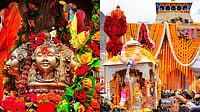
The revered Char Dham Yatra, a spiritual cornerstone for countless Indian pilgrims, officially commenced its 2026 season on April 19th with the ceremonial
opening of the temple gates at Yamunotri and Gangotri. This significant pilgrimage journeys through four hallowed abodes nestled within the Garhwal Himalayas. Following ancient tradition, devotees undertake this sacred circuit in a clockwise direction, a practice known as 'parikrama' or circumambulation. The spiritual sojourn begins in the west at Yamunotri, the source of the Yamuna River, then proceeds north to Gangotri, the origin of the Ganges. The arduous yet rewarding path ascends to the majestic Kedarnath, dedicated to Lord Shiva, before culminating in the east at Badrinath, a divine resting place of Lord Vishnu. This meticulously planned route ensures pilgrims experience the full spiritual essence of each holy site in a sequential, harmonious flow.
Yamunotri: Goddess's Origin
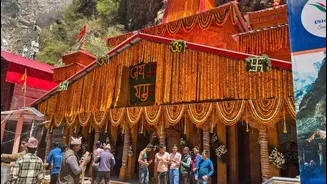
The spiritual pilgrimage commences at Yamunotri, situated at a lofty 3,293 meters, marking the westernmost point of the Char Dham circuit. This sacred shrine is devoted to Goddess Yamuna, the divine daughter of the Sun God and sister to Yama, the deity of death. The journey to the temple itself is a test of devotion, involving a challenging trek from Janki Chatti through rugged, narrow mountain passes. It is widely believed that immersing oneself in the holy waters of the Yamuna here offers protection against a premature demise. The present temple structure, a testament to human resilience against the formidable Himalayan climate, was originally erected in 1839 by Maharaja Pratap Shah of Tehri Garhwal, standing as a beacon of faith and endurance.
Gangotri: The Divine Flow
Proceeding further into the Uttarkashi district, the pilgrimage arrives at Gangotri, perched at an elevation exceeding 3,400 meters. This elegant temple, constructed from white granite by Gorkha General Amar Singh Thapa in the 18th century, is dedicated to Goddess Ganga. According to ancient lore, the celestial river Ganga was brought to earth by Lord Shiva, who released her from his matted locks to mitigate her powerful descent. While the temple serves as the primary site for religious ceremonies, the true source of the sacred river is located at Gaumukh, nestled within the Gangotri Glacier, approximately 19 kilometers away. This pristine origin point is accessible only through a demanding trek. At this altitude, the river is known as the Bhagirathi and only assumes the revered name 'Ganga' after its confluence with the Alaknanda at Devaprayag.
Kedarnath: Shiva's Abode
Scheduled to unveil its sacred doors on April 22, 2026, Kedarnath stands as one of the most awe-inspiring and physically demanding destinations on the Char Dham circuit. Situated on the banks of the Mandakini River and dwarfed by imposing peaks soaring to nearly 7,000 meters, this shrine is counted among the twelve revered Jyotirlingas. The spiritual aura of Kedarnath is deeply steeped in history, with legends connecting it to the era of the Mahabharata. It is believed that the Pandavas, seeking absolution for the bloodshed during the Kurukshetra War, found Lord Shiva at this site. As the story goes, Shiva, disguised as a bull, attempted to escape them by diving into the ground, leaving behind his hump as the primary object of worship. Today, the resilient temple stands as a profound symbol of spiritual fortitude, accessible either by a challenging 22-kilometer trek or via specialized helicopter services.
Badrinath: Vishnu's Sanctuary
The profound spiritual journey culminates at Badrinath, with its portals set to open on April 23, 2026. Resting at an altitude of 3,133 meters within the Chamoli district, Badrinath is a paramount pilgrimage destination for Vaishnavites and is recognized as one of the 108 Divya Desams. The central attraction is a striking one-meter-tall idol of Lord Vishnu, known as Badari Narayan, crafted from black stone and depicted in a serene meditative posture (Padmasana). A unique cultural highlight enriching the pilgrimage experience is the annual Badri-Kedar Festival, typically held between June and September. This vibrant festival commemorates the divine union of Vishnu and Shiva through colorful processions and traditional rituals, serving as a powerful cultural bridge between these two potent spiritual centers and showcasing the region's rich heritage.
Digital Preparations
For the upcoming 2026 Char Dham Yatra season, pilgrims are required to complete mandatory online registration through the official Uttarakhand tourism portal or their dedicated mobile application. This digital initiative is crucial for managing the influx of thousands of travelers and ensuring their safety by preventing overcrowding at the revered shrines. Entry to the temple premises will be strictly prohibited for individuals who have not obtained valid registration. The implementation of digital systems extends to security and logistical management, with registered pilgrims receiving QR codes or e-passes. These credentials will be scanned at various checkpoints throughout the pilgrimage route, enabling authorities to monitor pilgrim movement and respond effectively to any emergent situations in the challenging high-altitude terrain.
Health and Safety
Maintaining pilgrim well-being is a top priority for the authorities overseeing the Char Dham Yatra. Given the thin air and steep ascents, particularly on the route to Kedarnath, mandatory fitness assessments may be required. Travelers are strongly advised to allow several days for acclimatization to the altitude before commencing the strenuous climbs. Furthermore, the consumption of alcohol and the use of sleeping pills are strictly prohibited during the pilgrimage to ensure optimal health and safety. Safety measures also extend to road travel, with a strict ban on vehicular movement along mountain routes between 10 PM and 4 AM. All vehicles are subjected to thorough technical inspections to guarantee their suitability for navigating the narrow and sensitive mountain roads, thereby preventing delays and mitigating the risk of accidents.
Evolving Protocols
The 2026 Char Dham Yatra season is also witnessing discussions around potential new entry protocols. There are reports indicating that the temple management committees are considering implementing new regulations that could affect entry requirements for non-Hindu visitors at specific shrines, such as Badrinath and Kedarnath. This development has initiated a broader dialogue, exploring the delicate balance between preserving the sanctity of religious sites and upholding the pilgrimage's historical tradition of inclusivity. Such considerations highlight the ongoing efforts to manage and refine the pilgrimage experience for all participants.