




The Invisible Downpour
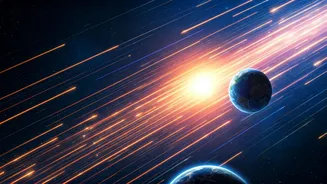
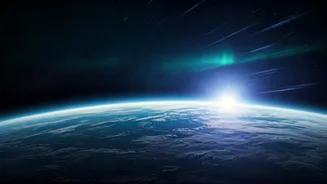
Imagine an unending shower, not of water, but of incredibly powerful, invisible particles streaming from the furthest reaches of our galaxy. These are
galactic cosmic rays (GCRs), and they are constantly passing through you and everything around us at speeds that verge on the absolute limit of light. While we can't perceive them directly, these energetic particles are fundamental components of our cosmic environment. They aren't actually 'rays' in the traditional sense but are primarily made up of stripped atomic nuclei, predominantly protons, alongside helium nuclei and, less frequently, heavier elements. These minuscule entities carry immense energy, far exceeding anything we typically encounter, and when they encounter Earth's atmosphere, they initiate a chain reaction, creating a cascade of secondary particles that reach the planet's surface. It's estimated that roughly one of these primary cosmic ray particles traverses the area of your palm every single second, a testament to their pervasive nature. This concept, though abstract, is so compelling that it has even found its way into popular science fiction, illustrating the real-world scientific principles that inspire fantastical tales.
Discovery in the Skies
The revelation of galactic cosmic rays began with a daring ascent in 1912. Austrian physicist Victor Hess embarked on a series of balloon flights, reaching altitudes of approximately 5,300 meters, armed with an electroscope designed to measure ionizing radiation. The prevailing scientific assumption was that radiation levels would decrease with altitude as one moved further from Earth's own radioactive crust. However, Hess observed a startling anomaly: the radiation intensified as he ascended. This effect persisted even during a partial solar eclipse, effectively ruling out the Sun as the primary source. This groundbreaking observation led Hess to the correct conclusion that the ionizing radiation was of extraterrestrial origin. His persistent inquiry and willingness to undertake such extraordinary measures in pursuit of knowledge were ultimately recognized with the Nobel Prize in Physics in 1936, solidifying his place in scientific history for uncovering this fundamental cosmic phenomenon.
Cosmic Engines and Sources
The origins of galactic cosmic rays are as varied as the celestial events that create them. The particles with lower energies are widely believed to stem from supernova remnants, the vast, expanding clouds of gas and dust ejected when massive stars meet their explosive end. Within these tumultuous environments, intense magnetic fields act as cosmic accelerators, repeatedly bouncing charged particles and imbuing them with tremendous energy, much like a high-stakes game of pinball. Supernovae are among the most potent energy sources known in our galaxy, and their resulting cosmic ray emissions can be thought of as their energetic 'exhaust.' Over billions of years, the Milky Way has accumulated this pervasive 'exhaust,' and our solar system, along with Earth, has been continually immersed in it. This continuous influx shapes our understanding of galactic evolution and our place within it.
Ultra-High-Energy Mysteries
The most energetic cosmic rays present a profound enigma to astrophysicists. These particles arrive with energies so immense that, theoretically, they should have been degraded over their vast cosmic journeys. As they traverse the universe, they are expected to interact with the pervasive cosmic microwave background radiation, losing their energy in the process. Yet, these ultra-high-energy cosmic rays reach Earth remarkably intact, implying that their points of origin must be cosmically 'close.' Leading candidates for these powerful sources include active galactic nuclei, which are supermassive black holes at the centers of galaxies that aggressively consume surrounding matter, and gamma-ray bursts, some of the most cataclysmic explosions known to occur in the cosmos. The detection and study of these particles push the boundaries of our understanding of extreme astrophysical phenomena.
Scrambled Paths, Detective Work
The charged nature of cosmic rays presents a significant challenge in tracing their origins. As they journey through space, these particles are deflected by the pervasive magnetic fields present both within our galaxy and in intergalactic space. These magnetic fields act like invisible mazes, bending the paths of cosmic rays and scrambling their original trajectories over the immense distances they travel. By the time these particles reach Earth, their directional information is so thoroughly confused that pinpointing their exact source becomes an almost impossible task through direct observation. Consequently, astronomers and physicists must adopt the methods of detectives, piecing together a multitude of indirect clues and theoretical models rather than simply following a particle's path backward.
Cosmic Rays in Action
The pervasive presence of cosmic rays has led to remarkable real-world applications, notably in archaeology. In 2017, a technique known as cosmic ray muon tomography was employed to scan Egypt's Great Pyramid of Giza. This innovative method utilizes the muons – secondary particles generated when cosmic rays collide with Earth's atmosphere – as a form of natural X-ray. Muons possess a greater penetrating power than any human-made scanner. This non-invasive technique successfully revealed a previously undetected void deep within the ancient monument, a chamber approximately 30 meters in length that had remained hidden for 4,500 years. This instance perfectly illustrates how the universe's own ongoing radiation, interacting with an ancient structure, can help solve long-standing historical mysteries.
Human Impact and Connection
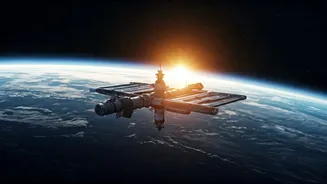
Beyond their geological and archaeological implications, cosmic rays also have a direct, personal impact on humans, particularly those venturing beyond Earth's protective atmosphere. Astronauts aboard the International Space Station, though partially shielded, are exposed to higher levels of cosmic radiation. Many have reported experiencing occasional flashes of light, perceived even with their eyes closed. This phenomenon, known as the 'phosphene' effect, is caused by cosmic rays passing directly through the delicate tissues of their retinas. This experience serves as a profound and intimate reminder that we are not merely passive observers of the cosmos, but are intrinsically part of it, constantly immersed in its energetic processes. As the physicist Carlo Rovelli aptly put it, these high-velocity messengers from distant stellar explosions and black holes pass through us daily, underscoring our deep connection to the universe.