




Desert Dwellers' Welcome
The vast, arid expanse of Egypt's Sinai Peninsula is the ancestral home of the Jebeliya Bedouin, a people deeply intertwined with their harsh yet beautiful
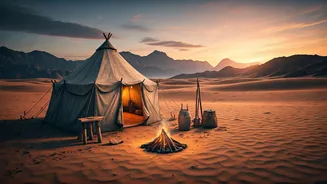
environment. For generations, they have thrived by harnessing an intimate knowledge of the land. Today, an increasing number of intrepid travelers are drawn to this unique culture, seeking to experience it firsthand through off-grid camping excursions. These journeys offer a profound opportunity to detach from the relentless pace of modern life and embrace the quiet simplicity and inherent beauty of the desert. Visitors are often extended a warm welcome into Bedouin family homes, where they share nourishing meals, exchange compelling stories, and gain invaluable insights into the local customs and traditions. Daily activities typically involve invigorating hikes through ancient wadis, exploration of secluded canyons, and the awe-inspiring spectacle of stargazing under an unpolluted desert sky. As night falls, gatherings around crackling campfires become the focal point, accompanied by the enchanting sounds of traditional music and captivating tales passed down through countless generations.
Sacred Monastery Roots
Nestled within this dramatic landscape lies St. Catherine's Monastery, an ancient and historically significant site. Even before reaching the monastery itself, visitors are often captivated by a unique natural feature: a bush, pruned and protected, that is said to be the very Burning Bush from biblical accounts. This botanical wonder draws pilgrims and curious travelers alike. Eid Mousa, a Bedouin guide, shares the lore surrounding the bush, emphasizing its 3,500-year existence and its sacred status across Christianity, Islam, and Judaism. Pilgrims often leave small notes with wishes tucked between the stones safeguarding the bush, embedding their hopes into the monastery's very foundations. Eid, despite his casual appearance, possesses a profound understanding of the monastery's history and significance, making him an invaluable guide to this globally revered location. The monastery itself, dating back to the sixth century, is described as the oldest hotel in Sinai, capable of hosting up to 150 guests. It is a living testament to a harmonious coexistence, with resident monks and Muslim Bedouin guardians working together to maintain this UNESCO World Heritage Site.
Guardians of the Mountain
The Jebeliya people are a semi-nomadic Arab community whose heritage is deeply rooted in the desert and mountainous terrains of North Africa and the Levant, including the area now designated as the St. Katherine Protectorate national park. Their enduring relationship with both the monastic community and the rugged mountains is a key aspect of understanding this region. Tours like the one described are often founded by members of the local Jebeliya tribe, offering immersive experiences that trace ancient pathways and involve overnight stays within small Bedouin communities. These journeys serve as a step-by-step exploration of nearly 1,500 years of history. The monastery, established by Emperor Justinian with monks and workers from the Eastern Mediterranean, owes its existence to the discovery of the Burning Bush at the foot of Mount Sinai, where Moses is said to have received the Ten Commandments. The families who came to establish the monastery eventually intermarried with the local Bedouin, forming the Jebeliya people, a lineage that has persisted since the sixth century. From vantage points above, the monastery appears small, dwarfed by the imposing mountains from which its stones were quarried, forming a natural protective wall.
Life-Sustaining Gardens
A surprising splash of green emanates from the monastery walls, a testament to the enduring power of cultivation in the desert. These gardens, planted concurrently with the original chapel foundations, are vital to the monastery's self-sufficiency. They boast an array of olive trees, apricot, and pomegranate varieties, with the gnarly olive trees alone numbering 5,000, flourishing in gardens situated on plateaus and within valley beds. The produce, particularly the olives, is transformed into oil, which the monks sell to support their traditional way of life. This garden is unequivocally credited with the monastery's centuries-long survival. Further exploration reveals more terraced gardens beyond the monastery's walls, featuring lower walls and a greater density of trees. Here, thin wisps of woodsmoke signal the presence of camouflaged stone dwellings, belonging to the Bedouin. These gardens are a shared resource, with Bedouin communities tending to them and taking what they need while respecting sustainable harvesting practices. The monastery's olive oil is renowned, and its gardens are meticulously cared for, often by a dedicated gardener from the Bedouin community who feels a profound connection to this solitary life, finding solace and self-discovery amidst the ancient trees and fertile soil.
Echoes of Ancient Trails
Venturing into the mountains reveals a landscape that, while appearing barren from a distance, teems with subtle signs of human history and enduring practices. Ancient rock dams, ingeniously built into valley contours, speak of water management techniques that have sustained life for centuries. Alongside these, giant boulders bear witness to history, etched with both sixth-century Byzantine inscriptions and the distinctive script of the Bedouin, resembling an open book. Even ancient Bedouin courting rituals are subtly represented by human foot outlines drawn on rocks, a visual cue left by hopeful suitors for female goat-herders. While actual goats may not be in immediate view, their droppings, along with those of camels and ibex, are common indicators of the wildlife that roams the St. Katherine Protectorate. These animals are a primary reason for the meticulously walled mountain gardens, a measure to protect crops. Wild mint, often found and offered for its refreshing scent and use in tea, grows abundantly. Striking cypress trees, more reminiscent of Mediterranean estates, mark land belonging to the monastery, a tradition dating back to Greek plantings. These gardens, some predating the monastery itself, continue to be cultivated by Bedouin families, blending their ancestral practices with the natural bounty of the mountains, creating a tapestry of life and history woven into the very fabric of the landscape.
Serenity and Starlight
The appeal of retreating to these mountains and embracing a life sustained by the land is undeniable. Upon arriving at a village camp nestled between the peaks of Mount Sinai and Mount Catherine, a sense of profound detachment from the outside world becomes palpable, despite being only a few miles on foot from the monastery. Camels transport the necessary gear, and pre-erected tents dot the landscape amidst a small orchard of fruit trees. Once the generator ceases its hum at 9 PM, a deep and pervasive silence descends upon the valley, broken only by the subtle sounds of the natural world. As dawn breaks, the first sensation is the gentle warmth of the sun on one's face, soon accompanied by the distant, melodic call to prayer from a mountain mosque. The scene is bathed in the soft hues of sunrise, with the foothills of Mount Sinai painted in warm, buttery tones. While the summit of Mount Sinai remains hidden from view due to the intricate layers of rock, the camp offers a serene starting point for an exploration that aims for a more contemplative experience, following ancient paths trodden by monks and tracing the footsteps of Moses, with the summit to be reached at sunset.
Ascent to the Summit
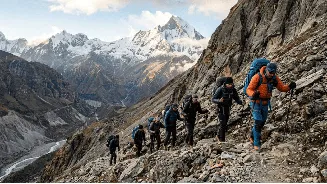
The journey towards the summit of Mount Sinai offers a rich tapestry of historical and natural wonders. The chosen route, known by the Bedouin as the Byzantine Way, unfolds over a full day, mirroring the paths of ancient monks who established solitary dwellings and gardens to sustain their spiritual existence. This trail, marked by faint, square Coptic crosses etched into rock faces, winds through dramatic landscapes. Participants navigate steep scrambles past giant, wind-sculpted granite boulders and ascend stairways carved directly into the rock, often finding themselves enveloped by towering canyon walls. During this ascent, a unique Bedouin snack called 'afig', a small nugget of dried goat's cheese with a distinct sour tang, is shared. The path leads to a small plateau revealing a remarkably preserved monk's refuge, comprising two stone dwellings, one of which serves as a tiny church, indicated by a simple square cross. The adjacent house, built decades ago by locals, still shows remnants of a tended garden. This site exudes an extreme sense of disconnection from the bustling world. Higher up, another stone dwelling and a well mark a lunch stop amidst a vertical labyrinth of rocky clefts. Here, local shrubs like 'merdj' are gathered for kindling, their aromatic scent released as the soil is disturbed. These herbs are crucial for enhancing the flavor of food cooked over an open fire, which includes roasted aubergines and boiled tea, accompanied by a vibrant salad of raw vegetables and olives. The meal is enjoyed on sun-baked boulders, followed by a restorative nap before the final push to the summit.
Peak Rituals and Reflection
The final ascent to the summit follows the original sixth-century route, known as the Steps of Repentance. Along the way, small teahouses near the peak offer refreshing mint tea, prepared for the incoming stream of pilgrims. Aside from a few sun-bathing cats, the steps are notably quiet during this part of the journey. The climb culminates beside a small mountaintop church, its charred walls bearing testament to nights spent huddled around fires, remarkably close to the stars. The experience of summiting is elevated by a ritualistic act: ringing a large bell hung from a stone archway attached to the chapel. The panoramic view from the peak is breathtaking, a 360-degree vista of mountain ranges resembling tea-stained, crumpled parchment. Following the tolling of the bell, there is an opportunity to join Nasser in prayer at a mosque, a tiny, unassuming structure that has stood for centuries alongside the monks' church. This dual-faith presence at the summit symbolizes a deep historical coexistence. Inside the mosque, the simple, square chamber is adorned with prayer mats and hand-painted walls featuring Arabic script. The quiet contemplation within this sacred space, coupled with the profound sense of peace that settles upon weary bodies, offers an unexpected and deeply moving spiritual experience.
Herbal Wisdom of Sinai
The deep-rooted connection of the Jebeliya tribe to these mountains is as compelling as the hiking itself. Further insight into this connection is gained during a final night spent with Nasser's nephew, Ahmed Mousa, founder of Sinai Hikes, and his grandfather, Ahmed Mansour. The elder, a septuagenarian, resides in a home situated on a slope below another ancient church, a journey of over an hour from the nearest road. The home is surrounded by Bedouin gardens featuring date and carob trees, carefully delineated by stone walls and irrigated by natural mountain springs – the only modern elements in an otherwise timeless landscape. The mountain range is effectively the elder's garden. He is known as the last herbalist of Sinai, dedicated to preserving the region's natural medicinal knowledge, which is at risk of being lost. This ancient practice, known as 'hakeem katrine' or 'wise man of St Catherine,' was once the traditional Bedouin term for 'doctor.' Even today, Jebeliya people in the hills seek treatment for ailments such as asthma, wound infections, and stomach problems from him. For over fifty years, he has experimented with tribal recipes, sourcing ingredients – herbs, shrubs, and even mineral-rich sands from ancient caves – from the surrounding hills. He explains that attempting to cultivate the herbs elsewhere diminishes their medicinal potency, hence his practice of preparing remedies on-site using locally gathered ingredients. His living room is a testament to a lifetime of meticulous preparation, filled with an array of pots, pans, sieves, and jars of dried herbs and spices, all arranged over a natural rock gravel floor that facilitates a seamless transition between indoor and outdoor spaces.
A Timeless Spiritual Connection
The final days are spent in the company of the herbalist, sharing tea and coffee, and exploring ancient irrigation channels that gracefully descend through his property. He showcases his stores of carob, built into the natural crevices of boulders, the fruit intensely desiccated, releasing a potent aroma. He explains his plan to transform these pods into molasses for 'carob honey,' a highly sought-after remedy for anemia, particularly by customers in Saudi Arabia willing to pay a premium. However, the true value lies not just in the remedies but in the experience of witnessing his natural medicine 'cupboard' firsthand. As sunset approaches, casting a cool purple haze over the valley, the herbalist, his wiry white beard gently ruffled by the breeze, continues to converse by the warmth of a fire. He expresses a profound belief that these mountains hold a unique spirituality, different from any others. This feeling of deep connection and spiritual resonance is palpable, underscoring the enduring allure of the Sinai's rugged beauty and the timeless wisdom of its people.