







The Growing Debris Problem
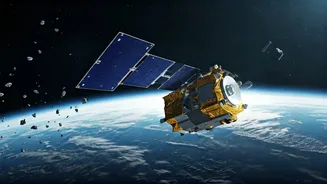
The increasing volume of space debris poses a significant and worsening threat to Earth observation satellites, which are essential for gathering data
to understand our planet's climate. These vital instruments are increasingly compelled to perform evasive maneuvers to avoid collisions, a necessity that unfortunately leads to corrupted or lost scientific data. This issue is particularly concerning for constellations like the Earth Observing System (EOS) fleet, comprising satellites such as Aqua, Terra, and Aura, which work in concert to monitor land, ocean, and atmosphere. Since 2005, these satellites have executed numerous avoidance maneuvers, some of which have resulted in corrupted climate datasets. Beyond data integrity, these actions also deplete precious fuel reserves, shortening the operational lifespan of these invaluable scientific tools. The economic impact is also substantial, as noted by insurance providers who must factor collision risks into their pricing, acknowledging that even avoiding a collision carries a direct cost in terms of lost fuel.
Impact on Climate Data
The escalating presence of space junk significantly hinders our ability to collect uninterrupted and accurate climate data, a critical component for informing policy decisions regarding climate change. Satellites like Aqua, which orbit closer to Earth to capture detailed observations, are particularly vulnerable. These low Earth orbit (LEO) environments are densely populated with debris, moving at high velocities. The consequences of debris avoidance are multifaceted: each maneuver consumes finite fuel, directly impacting a satellite's longevity. Furthermore, the act of dodging can introduce anomalies into the data streams, compromising the scientific integrity of measurements. For instance, tasks requiring high-resolution imagery or frequent revisits to specific areas may become unreliable or impossible to complete. This lost or corrupted data creates gaps in our understanding, making it more challenging to present a clear picture of Earth's changing climate to decision-makers.
Fuel Depletion and Longevity
The continuous need for satellites to perform evasive maneuvers to avoid space debris is a significant factor in their reduced operational lifespan due to accelerated fuel depletion. While satellites inherently require trajectory corrections to counteract gravitational pulls from celestial bodies and solar radiation, the added burden of avoiding orbital clutter consumes a substantial portion of their fuel. For a satellite like Aqua, which has already exceeded its designed lifespan by 18 years thanks to careful fuel management, the prospect of longer missions is hampered by this critical resource limitation. Scientists acknowledge that if future missions were designed with the expectation of 20-year lifespans, incorporating more fuel could extend their utility even further. However, the current reality of a crowded orbit necessitates frequent fuel expenditure for survival, meaning less fuel is available for extended scientific observation or for safely de-orbiting the satellite at the end of its mission.
Escalating Risks and Costs
The risks associated with space debris are not only increasing but also bringing about escalating costs, impacting satellite insurance and potentially threatening the survival of space-faring organizations. The European Space Agency (ESA) has projected a significant rise in collision risk, with numbers expected to climb considerably in the coming years. This heightened danger makes insuring satellites increasingly difficult and expensive, forcing non-governmental organizations and government agencies to shoulder a greater share of the financial burden and risk. Incidents like the failure of the MethaneSAT satellite, which ceased transmitting data shortly after launch, and the premature malfunction of SatVu's HOTSAT-1 satellite, highlight the vulnerability of even new missions. These events underscore that the cost of losing a satellite due to debris is not merely a financial setback but can represent an existential threat to companies and essential scientific endeavors.
The Future Outlook
The trajectory of space debris suggests that conditions are likely to worsen before any potential improvement, presenting a challenging future for orbital operations. Projections indicate a substantial increase in the number of tracked debris pieces, with a far greater, untracked multitude of smaller objects posing a constant threat. Even minuscule particles, such as paint flecks, can cause catastrophic damage to satellites. The creation of this debris is an ongoing issue, stemming from satellite breakups, collisions, and anti-satellite weapon tests, which can trigger cascading collision events, a scenario known as Kessler Syndrome. While some organizations are developing advanced tracking and removal technologies, the immediate future points towards a more crowded and hazardous orbital environment, demanding innovative solutions and international cooperation to mitigate the growing risks to vital scientific infrastructure and future space exploration.