


Eclipse Timings Unveiled
The celestial dance of the Moon, Earth, and Sun culminates in a spectacular total lunar eclipse on March 3, 2026, offering a prime opportunity for stargazers.
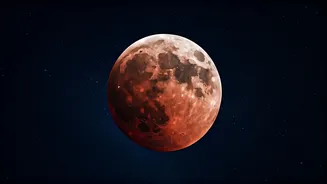
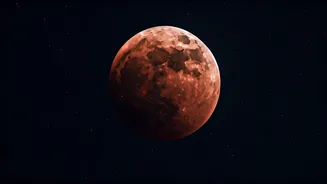
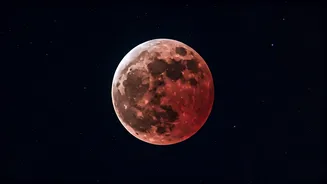
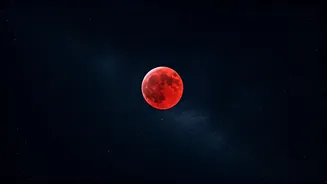
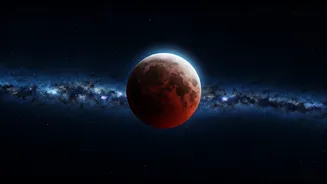
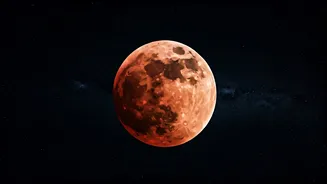
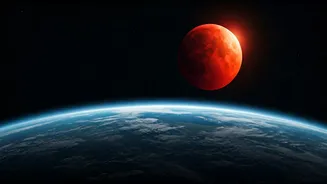
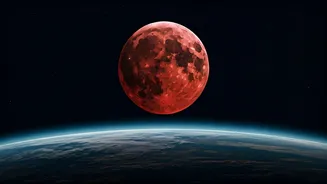
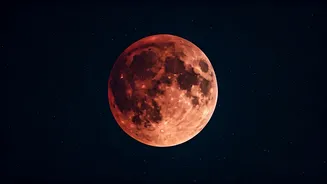
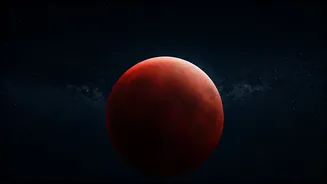
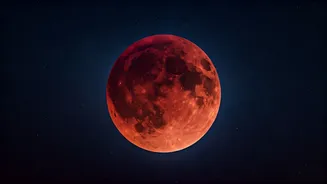
The astronomical spectacle commences with the penumbral lunar eclipse starting at 09:05 AM UTC. This is when the Earth's faint outer shadow begins to fall upon the Moon. Following this, the partial lunar eclipse begins at 10:42 AM UTC, marking the moment when the Earth's darker inner shadow, the umbra, starts to obscure a portion of the lunar disk. The peak of this breathtaking phenomenon, the total lunar eclipse, is scheduled for 11:43 AM UTC. During totality, the Moon will be completely enveloped by the Earth's umbra, often acquiring a distinct reddish hue. This phase of complete obscuration will last until 12:59 PM UTC, providing a substantial window for observation. The partial lunar eclipse then concludes at 02:00 PM UTC, as the Moon begins to exit the umbra. Finally, the penumbral lunar eclipse will end at 03:37 PM UTC, signaling the conclusion of this captivating lunar event. It's essential to convert these UTC times to your local time zone to ensure you don't miss any part of this magnificent display.
Visibility Across India
For residents of India, the total lunar eclipse on March 3, 2026, promises an impressive viewing experience, though specific timings will vary by region. The entire event, from the initial penumbral phase to its conclusion, will be observable across the country, provided clear skies prevail. The key phases, particularly the partial and total eclipses, will be visible in the late afternoon and early evening. For instance, in major metropolitan areas, the partial eclipse is expected to begin around 03:12 PM IST (Indian Standard Time) and the total eclipse will commence approximately at 04:13 PM IST. Totality will reach its zenith around 05:14 PM IST, bathing the Moon in a coppery glow, and will continue until roughly 06:15 PM IST. The partial eclipse will conclude around 07:00 PM IST. Cities like Mumbai, Delhi, Kolkata, Chennai, and Bengaluru will all have excellent vantage points. It is advisable to check local astronomical society websites or reliable weather forecasts closer to the date for precise timings and any potential localized atmospheric conditions that might affect visibility. Ensuring an unobstructed view towards the western horizon during the latter stages of the eclipse is recommended.
Optimal Viewing Guide
To fully appreciate the total lunar eclipse on March 3, 2026, a few simple preparations can enhance your experience. Unlike solar eclipses, lunar eclipses are perfectly safe to view with the naked eye; no special protective eyewear is required. The best approach is to find a location with minimal light pollution. Parks, open fields, or even your own backyard away from streetlights can offer a darker, clearer view of the night sky. The Moon will be visible as it rises in the sky, so try to face the direction where the Moon will be. Binoculars or a telescope can significantly enhance the view, allowing you to observe the subtle color changes on the lunar surface during totality and the fascinating details of craters and maria. Patience is key; take your time to observe the gradual transformation of the Moon. Photography enthusiasts might want to set up their cameras beforehand, using a tripod to ensure sharp images, especially during the low-light conditions of totality. Consider bringing a comfortable chair and a warm beverage to make the observation period more enjoyable, especially if the weather is cool.