



Salar de Uyuni's Mirror
Imagine standing on a vast expanse where the sky meets the earth in a perfect reflection. Salar de Uyuni in Bolivia, the world's largest salt flat, transforms
into a colossal natural mirror during the rainy season (roughly December to April). When a thin layer of water covers the salt, the surface becomes so flat and reflective that it creates an illusion of walking on clouds or within the sky itself. This phenomenon is not just visually stunning but also a photographer's paradise, offering surreal perspectives where the horizon disappears and the boundaries between the real and the reflected blur into an ethereal landscape.
Pamukkale's Cotton Castle
Pamukkale, meaning 'Cotton Castle' in Turkish, is a breathtaking natural wonder characterized by its gleaming white terraces formed by travertine, a mineral-rich water. These terraced pools, created by thermal waters cascading down a hillside, resemble a frozen waterfall or a surreal cotton landscape. The mineral-laden water, rich in calcium carbonate, precipitates out of the water, solidifying over time to form these unique, step-like formations. The striking contrast of the white terraces against the azure sky and the surrounding landscape makes Pamukkale a truly otherworldly destination, inviting visitors to soak in the mineral-rich waters and marvel at its geological artistry.
Giant's Causeway's Hexagons
Venture to the Antrim coast of Northern Ireland to witness the extraordinary Giant's Causeway. This UNESCO World Heritage site is composed of approximately 40,000 interlocking basalt columns, mostly hexagonal in shape, which are the result of ancient volcanic activity. Legend has it that the giant Finn McCool built the causeway to walk to Scotland, but geological evidence points to the cooling and contracting of lava flows. The striking geometric patterns of these pillars, plunging into the sea, create a landscape that appears meticulously crafted, yet is entirely a product of natural forces, evoking a sense of wonder and myth.
Zhangjiajie's Avatar Mountains
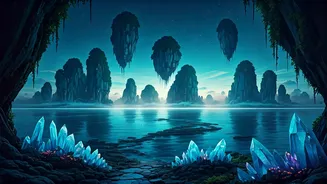
In the Hunan Province of China lies Zhangjiajie National Forest Park, a landscape that famously inspired the floating mountains of Pandora in the movie 'Avatar'. Towering sandstone pillars, some reaching over 1,000 meters high, are cloaked in lush vegetation and shrouded in mist, creating a dreamlike, ethereal atmosphere. These geological formations were carved by erosion over millions of years, with wind and water shaping the landscape into these dramatic, vertical monoliths. The park offers breathtaking vistas from various viewpoints and cable car rides, allowing visitors to immerse themselves in this truly alien yet terrestrial environment.
Plitvice Lakes' Cascades
Croatia's Plitvice Lakes National Park is a spectacle of sixteen terraced lakes, interconnected by a series of stunning waterfalls and streams. The water's vibrant turquoise and emerald hues are a result of minerals and organisms in the water, changing color with the mineral content and sunlight. The park's unique geological formations, including tufa barriers, have been created over thousands of years by the deposition of calcium carbonate, forming natural dams that separate the lakes. Walking along the wooden pathways that crisscross the park, one feels enveloped in a pristine, magical ecosystem where water, rock, and life harmoniously coexist.
Son Doong Cave's Scale
Deep within Vietnam's Phong Nha-Ke Bang National Park lies Son Doong Cave, recognized as the world's largest cave passage. Its immense scale is almost incomprehensible, with chambers so vast they could contain entire skyscrapers. The cave boasts its own jungle, river, and weather systems, including clouds that form within its humid expanse. Formed by the erosion of limestone by river water over millions of years, Son Doong offers a truly subterranean world, complete with unique geological formations like colossal stalagmites and a collapsed roof section that allows sunlight to filter in, nurturing a distinct ecosystem.
Antelope Canyon's Light Beams
Located on Navajo land near Page, Arizona, Antelope Canyon is a slot canyon renowned for its breathtaking sculpted sandstone walls and the dramatic light beams that pierce through the narrow openings. The canyon was formed by millions of years of flash flooding and erosion, which smoothed the sandstone into flowing, organic shapes. The interplay of light and shadow within the canyon is mesmerizing, with sunbeams creating ethereal shafts of light that illuminate the sandy floors and highlight the vibrant colors of the rock. Visiting Antelope Canyon offers an almost spiritual experience, a journey into the heart of the earth's artistic power.
Danakil Depression's Colors
The Danakil Depression in Ethiopia is one of the hottest and lowest places on Earth, a geological wonderland characterized by an alien landscape of vibrant colors and extreme conditions. Dominated by volcanic activity, salt flats, and acidic springs, the region features striking patterns of yellow, green, and red created by mineral deposits. Dallol, a hydrothermal field within the depression, is a prime example, with bubbling pools, sulfur springs, and surreal geological formations resembling an extraterrestrial terrain. Despite its harsh environment, Danakil Depression is a testament to Earth's raw geological power and its capacity for creating unparalleled, vibrant beauty.
Cave of the Crystals' Giants
Beneath the Naica Mine in Mexico lies the astonishing Cave of the Crystals, a subterranean chamber filled with colossal selenite crystals. These gypsum formations, some reaching lengths of up to 12 meters and weighing many tons, are among the largest natural crystals ever found. The cave's unique environment, with its stable, high temperature (around 58°C) and mineral-rich water, allowed these gigantic crystals to grow over hundreds of thousands of years. The sight of these translucent, towering pillars creates an almost magical underground cathedral, a true marvel of geological formation and a rare glimpse into Earth's hidden wonders.
Bioluminescent Bays' Glow
Experience the magic of bioluminescent bays, where microscopic organisms in the water emit light when disturbed, creating a natural light show. Mosquito Bay in Vieques, Puerto Rico, is one of the brightest and most accessible examples, with millions of dinoflagellates illuminating the water with an otherworldly blue-green glow. When a kayak paddle or a swimming hand moves through the water, it triggers a cascade of light, transforming the dark sea into a shimmering spectacle. This natural phenomenon, driven by the organisms' chemical reactions, offers an enchanting and unforgettable encounter with nature's luminous capabilities.