
A New Propulsion System
In December, NASA and GE Aerospace reached a crucial milestone in developing hybrid-electric engine technology for future commercial aircraft. They unveiled
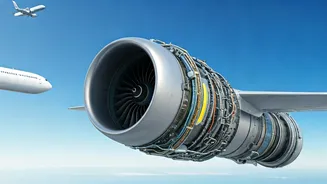
a hybrid engine demonstrator that aims to reduce fuel consumption by 10% compared to the best engines currently used in single-aisle, narrowbody aircraft. Previously, the partners had only tested individual parts and systems, but this marked the first time they assembled everything and tested the modified GE Passport engine on a mount. A NASA manager noted the project was nearing its payoff. The initiative, named Hybrid Thermally Efficient Core (HyTEC), aims to harness NASA's resources to advance hybrid engine technology, potentially appearing in commercial aircraft as early as the 2030s. The engine has been designed to provide the same thrust as existing engines used in single-aisle aircraft.
Electric and Fuel Efficiency
The high-bypass commercial turbofan engine uses GE's electric motor and generators, which are aided by electric power. This design helps minimize jet fuel use. The system is engineered to function with or without batteries or other energy storage methods. According to NASA, the engine extracts energy from specific operations and directs this extra power to other areas. Similar concepts, such as Electra's EL9 or VoltAero's Cassio, use electric power for takeoff and landing, but use a gas turbine to charge batteries during the cruise phase. The project manager observed that even though turbines and compressors already exist, a hybrid-electric engine was not yet flying, making the recent test a significant achievement. The test was conducted at GE's Peebles Test Operation site in Cincinnati, demonstrating successful power injection, extraction, and transfer, exceeding performance standards set by NASA in collaboration with the private sector. NASA described it as one of the most complex demonstrations GE had ever undertaken.
Future Developments Planned
The partners will analyze test data and work towards a compact engine test later this decade. It was estimated that this test would happen by 2028. The program lead mentioned that this will be the first mild hybrid-electric engine and could lead to the first production engine for narrowbody airliners that is hybrid electric. Earlier in the month, NASA also completed a scale model test for a wing intended to decrease drag through laminar flow, another efficiency-focused technology. Alongside other government and commercial entities, the space agency is exploring various efficiency-driven technologies, from advanced materials to uncrewed traffic management (UTM) systems. GE plans to sell megawatt-class, hybrid-electric power systems for both military and commercial single-aisle aircraft, aiming to improve fuel efficiency and lessen emissions. In 2021, the company committed to reaching carbon-neutral operations by 2030 and net-zero emissions by 2050.
RISE and Engine Integration
GE's December test supports efforts under RISE (Revolutionary Innovation for Sustainable Engines), a technology demonstrator project co-led with Safran Aircraft Engines through Safran's CFM International venture. More than 2,000 engineers are involved in the program, targeting a 20% fuel saving. Unveiled in 2021, the RISE demonstrator has conducted over 350 tests on open fan engine systems, hybrid-electric propulsion, and technologies compatible with hydrogen and sustainable aviation fuel (SAF). GE is working on aircraft and engine integration, planning ground and flight tests this decade. A large amount of electric and hybrid testing occurs at the University of Dayton in Ohio, where it has invested nearly $100 million in a 138,000-square-foot research and development hub. The company has multiple demonstrators to test how electrical power systems integrate with turboshaft, turboprop, and turbofan gas engines.
Beyond HyTEC Projects
Outside of HyTEC, GE collaborates with NASA, Boeing, and others, including BAE Systems, for ground and flight tests of a hybrid-electric powertrain, projected to be completed by 2030. A $197 million NASA contract will support integrating GE's CT7-9B turboprop on a Saab 340B testbed. Boeing will modify the testbed with a nacelle, flight deck software, and other components. NASA's goal is to introduce this technology to commercial aviation fleets by 2035. The U.S. Army is examining GE's hybrid engines through its Applied Research Collaborative Systematic Turboshaft Electrification Project (ARC-STEP), which conducted a review in late 2024. GE, under a $5.1 million contract, will research, develop, and test a megawatt-class, electrified powerplant to assess its performance on military rotorcraft. The CT7 turboshaft and GE's electric motor and generator will also be integrated into Sikorsky's Hybrid-Electric eXperimental (HEX) demonstrator, planned as a prototype for a commercial model.
Investments in Beta Technologies
GE made an investment in Beta Technologies, which develops two electric aircraft, demonstrating confidence in the prospects of hybrid-electric passenger transport. By combining its CT7, T700, and other engine systems with Beta's permanent magnet electric generators, GE plans to develop a hybrid-electric turbogenerator for vertical takeoff and landing (VTOL) aircraft, including Beta's, and other advanced air mobility (AAM) applications. The progress made in December represents a crucial moment for the future of aviation. This technology has the potential to significantly improve the sustainability of air travel. With ongoing research and collaboration, hybrid-electric engines could become a standard feature in commercial air travel in the coming years.