





Artemis Architecture Shift
NASA has announced a significant alteration to its Space Launch System (SLS) configuration for the ambitious Artemis program, which aims to return humans
to the moon. Instead of the previously planned upgrades to a more powerful Exploration Upper Stage (EUS) for later missions, the agency is moving towards a standardized SLS design. This new approach will utilize the Centaur V upper stage, a powerful and reliable component currently employed on other launch vehicles. This decision streamlines the program, potentially reducing development complexities and costs associated with designing entirely new upper stages. The focus is now on leveraging existing, well-tested technology to ensure mission success and maintain a consistent operational framework for future lunar expeditions, marking a pivotal moment in the ongoing development of NASA's lunar exploration capabilities.
The Centaur V Advantage
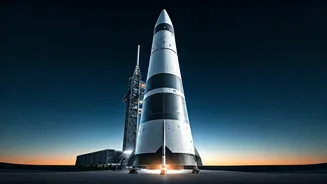
The Centaur V upper stage, chosen by NASA for the standardized SLS, boasts a strong flight heritage and advanced capabilities. It is powered by two RL10 engines and represents the most sophisticated iteration in the Centaur lineage, carrying roughly double the propellant of its predecessor, the ICPS. Its substantial fuel capacity and near-matching diameter to the Orion spacecraft and its service module make it an ideal candidate for deep space missions. The Centaur V's predecessors have a notable history of successful launches, demonstrating the reliability of its underlying technology. This proven track record, combined with its superior performance characteristics, makes the Centaur V a compelling choice for powering the Orion capsule and its crew on their journey to the lunar surface, ensuring a robust and dependable propulsion solution.
Accelerated Mission Timelines
This strategic adoption of the Centaur V upper stage is intrinsically linked to NASA's revised schedule for the Artemis missions. While Artemis 2, slated for an early April launch, remains unaffected, subsequent missions are being accelerated and reprogrammed. Artemis 3, originally envisioned as the inaugural lunar landing in 2028, is now a 2027 test flight focusing on orbital operations with Orion and lunar landers. The responsibility for the first crewed lunar landing now falls to Artemis 4, still targeted for 2028, with a potential follow-up on Artemis 5 in the same year. This accelerated cadence signifies NASA's commitment to swift progress in lunar exploration, with the standardized SLS and Centaur V acting as crucial enablers for achieving these ambitious timelines and establishing a sustained human presence on the moon.
Focus on Artemis 4 & 5
The current contract specifications from NASA clearly indicate that Artemis 4 and Artemis 5 are the confirmed missions designated to utilize the Space Launch System (SLS) in its standardized configuration, powered by the Centaur V upper stage. These missions are pivotal as they represent the next significant steps in the Artemis program's objective of returning astronauts to the lunar surface. While the contract details do not explicitly mention missions beyond Artemis 5, the adoption of a standardized SLS design with the Centaur V suggests a potential for its continued use in future lunar endeavors. This strategic decision aims to build a reliable and repeatable launch system, laying the groundwork for sustained lunar operations and long-term exploration objectives beyond the initial Artemis missions.