






The Hamsa's Embrace
The Hamsa hand, a palm-shaped amulet with an eye at its core, originates from Middle Eastern and North African cultures. Its name, 'Hamsa,' signifies five,
representing protection, blessings, and strength. Commonly seen as jewelry or wall decor, it acts as a divine shield against envy and malevolent forces. In contemporary times, it has transcended cultural borders, becoming a globally recognized spiritual accessory. The outstretched palm serves a dual purpose: repelling negativity while simultaneously inviting positive influences into one's life, creating a harmonious balance.
Nazar's Blue Gaze
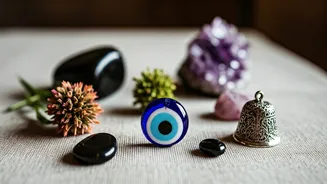
The blue Nazar bead, perhaps the most recognized evil eye deterrent worldwide, has its roots in Mediterranean and Middle Eastern traditions, particularly popular in Turkey and Greece. This amulet features striking concentric circles in blue, white, and black, mimicking an eye. The fundamental belief is that this 'eye' reflects malevolent gazes back to their source, rendering them harmless. In India, it's frequently attached to infants' clothing, placed in cars, or fashioned into bracelets and necklaces. Households often position a Nazar near their entrance to protect the home from undesirable energies. Beyond its superstitious aspect, the Nazar functions as a visual cue, a psychological barrier reinforcing a sense of security and protection.
Sacred Symbols' Power
Across various faiths, certain symbols are revered for their protective qualities. In Hindu traditions, the 'Om' symbol or images of Lord Hanuman are placed at entrances, while Christians often wear a cross, and Islamic adherents display or recite verses like Ayatul Kursi for safeguarding. These objects serve as focal points for faith, acting as anchors that strengthen spiritual resolve. Over generations, these practices have fostered a collective sense of reassurance, with these visible markers of belief reinforcing inner fortitude. They serve as constant reminders of a higher power's watchfulness, offering solace during times of uncertainty and transforming everyday spaces into sanctuaries of spiritual and emotional security. The potency of these symbols lies significantly in the strength of the belief itself.
Nimbu Mirchi Ritual
In India, a common sight outside homes, shops, and vehicles is a lemon pierced with seven green chilies, known as nimbu-mirchi. This weekly ritual is deeply embedded in folk beliefs, where the sharp taste of the lemon and the spiciness of the chilies are thought to ward off negative influences. Some folklore suggests this offering appeases Alakshmi, the goddess of misfortune, by providing her with something bitter and pungent, encouraging her to bypass the premises. Even for those who view it symbolically today, the practice of replacing this arrangement, typically every Saturday, remains a widespread protective measure across urban and rural landscapes.
The Black Thread
A simple black thread, known as kala dhaaga, tied around the wrist, ankle, or waist, represents one of the most understated yet powerful forms of protection in Indian households. Black is conceptually understood to absorb negative energies rather than deflect them. It's common for infants to wear a black thread around their ankles, while adults may tie it discreetly on their wrists. Often, a small prayer or affirmation is recited while tying the thread, enhancing its intended protective purpose. This minimalist and cost-effective practice embodies faith in its most elemental form: quiet, personal, and deeply effective.
Salt's Cleansing Touch
Salt has been recognized for its purifying properties across numerous cultures for centuries. In many Indian households, a handful of salt is rotated around a person's head before being discarded, a practice believed to cleanse them of the evil eye. Some individuals keep bowls of rock salt in the corners of rooms, convinced it absorbs detrimental vibrations. Others incorporate salt into their bathwater for energetic renewal, particularly after experiencing emotionally taxing events. Even outside of strictly spiritual contexts, salt is intrinsically linked to cleansing and grounding, offering a tangible act that promotes a profound sense of renewal and energetic clarity.