



A Samosa's Quest
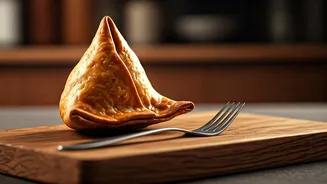
In a significant development for culinary enthusiasts, the humble yet immensely popular Indian samosa has achieved a landmark entry into the 2026 British
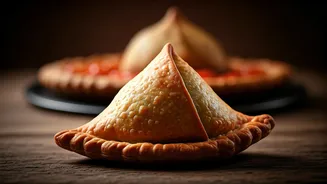
Pie Awards. This marks the first occasion in the award's 18-year history that a samosa has been considered for entry. The breakthrough was spearheaded by Keran Turakhia, widely recognized in the UK as '@samosawallah1'. This unique inclusion has naturally ignited a conversation about the very essence of what constitutes a pie, especially given the samosa's traditional preparation method. The journey to the awards involved a clever adaptation by Turakhia, who developed a baked version of the samosa to meet the competition's requirement for baked entries, while ingeniously retaining its characteristic flavorful fillings and utilizing an oven-suitable pastry.
Defining the Pie
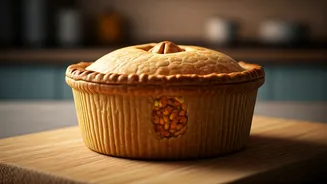
At its core, a pie is conventionally understood as a baked culinary creation featuring a pastry enclosure designed to encase a filling. This filling can be either sweet or savory, offering a wide spectrum of potential ingredients. The pastry itself is a fundamental component, typically crafted from a mixture of flour, fat, and water, forming either a base, a top, or both layers that define the pie's structure. Historically, sweet pies have often showcased fruits, creamy custards, or crunchy nuts, whereas their savory counterparts commonly incorporate hearty meats, wholesome vegetables, or rich cheeses. This definition forms the benchmark against which new contenders, like the samosa, are measured, prompting a closer look at its structural and compositional similarities.
The Ancient Origins of Pies
The concept of pies stretches back through millennia, with historical evidence pointing to their development in ancient civilizations. It is believed that the Egyptians, around 2000 BCE, were among the earliest to experiment with pastry-based dishes. Their rudimentary pies were crafted from simple doughs made of grain and water, used to enclose fillings primarily composed of honey. These early iterations were less like the pies we recognize today and more akin to flat, sweet pastries, providing a portable and delectable treat. This ancient lineage underscores the long-standing human tradition of combining dough with various fillings, a practice that has evolved dramatically over centuries.
Unpacking the Samosa
A samosa is fundamentally a popular deep-fried snack originating from the Indian subcontinent. Its exterior is typically made from refined flour, fat, salt, and oil, which is then fried to achieve a golden, crispy texture. The heart of the samosa lies in its vibrant and often spicy filling. Traditionally, this filling is based on boiled and mashed potatoes, seasoned with an array of aromatic spices. However, the versatility of the samosa is remarkable, with variations incorporating ingredients such as noodles, peas, cauliflower, various meats, and even surprising sweet elements like chocolate. This adaptability highlights its status as a canvas for diverse culinary creations.
Tracing Samosa's Roots
The lineage of the samosa can be traced back to the Middle East, with mentions appearing as early as the 10th century. The earliest documented reference to a precursor of the samosa was found in the extensive historical writings of the Iranian scholar Abolfazl Beyhaqi, in his work 'Tarikh-e Beyhaqi'. Here, it was referred to as 'Sambosa'. These original versions were notably small in size, a characteristic that made them exceptionally suitable as a travel snack. Their compact form allowed them to be easily carried in saddlebags, enabling travelers to enjoy a flavorful and filling bite on the go, demonstrating an early form of portable cuisine.
Samosa vs. Pie Debate
The question of whether a samosa truly qualifies as a pie sparks considerable discussion and elicits varied opinions. While the debate persists, both items can be broadly categorized under the umbrella of 'filled pastries.' This broader classification acknowledges the fundamental similarity: dough is ingeniously used to envelop or support a filling prior to cooking. The inclusion of the samosa in the British Pie Awards, albeit in a baked form, invites a closer examination of these shared characteristics and pushes the boundaries of traditional definitions. Ultimately, the enjoyment of the samosa, whether one considers it a pie or not, remains a testament to its enduring appeal and culinary ingenuity.