




Robotic Expedition Unveiled
An ambitious expedition involving three distinct robots has shed light on the potential for discovering human bases on Mars. The mission focused on exploring
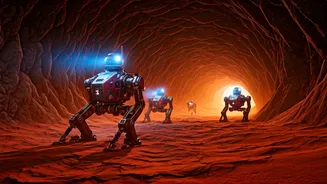
unique geological formations known as planetary skylights, which are essentially openings leading to subterranean tunnels. These lava tubes, often found on celestial bodies like Mars and the Moon, offer promising environments for future settlements due to their natural protection from radiation and extreme surface temperatures. The exploration utilized a trio of specialized robots: the SherpaTT, the Coyote III, and the LUVMI-X. Each robot was engineered with unique capabilities, essential for traversing the challenging, rugged terrain that closely mimics the Martian landscape. This collaborative effort underscores the complexity and ingenuity required for deep space exploration and resource identification.
Cooperative Robotics for Caves
The exploration of a lava tube, much like a cave entrance, necessitates a synergistic approach involving a team of specialized robotic units, each contributing to the mission's success. In a simulated test scenario, the SherpaTT rover assumed a crucial role as a stationary anchor and power source, providing a stable platform for other operations. Following this, the more compact Coyote III rover was skillfully lowered into the skylight using a tether, enabling it to navigate the precarious, rocky descent with precision. This division of labor allowed for the seamless sharing of vital data, power, and positional stability among the robots. By distributing tasks, the team effectively extended its reach into hazardous underground regions, areas that would be virtually inaccessible and too risky for a single robot to explore and egress from safely. The integrated functioning of the SherpaTT and Coyote III robots was instrumental in making the exploration of these challenging subterranean environments a reality.
Scouting for Resources
The LUVMI-X robot acted as the primary scout, meticulously examining the interior and immediate surroundings of the lava tube. Beyond mere reconnaissance, this robot was equipped with sophisticated instruments designed to detect potential indicators of water or ice, crucial resources for future human habitation. It also analyzed the atmospheric conditions within the cave. The LUVMI-X diligently surveyed the area around the entrance, capturing high-resolution imagery that proved invaluable in the team's decision-making process for selecting the optimal entry point for further exploration. Its observations provided critical insights into the cave's structure and potential habitability.
Paving the Way for Colonies
The successful outcomes of this mission have provided definitive proof of the high effectiveness of autonomous robotics in exploring the most formidable planetary environments, including those on the Moon and Mars. The findings clearly demonstrate the practicality of employing a coordinated team of advanced, next-generation rovers to gather comprehensive data on the internal and external characteristics of lava caves. By developing the capacity to navigate environments that are completely devoid of light and GPS signals independently, these robots are transforming theoretical concepts from science fiction into tangible realities. This breakthrough is effectively laying the groundwork for the establishment of the first self-sustaining human settlements beyond our home planet, proving that complex extraterrestrial structures can be accurately mapped and understood without continuous human oversight.