



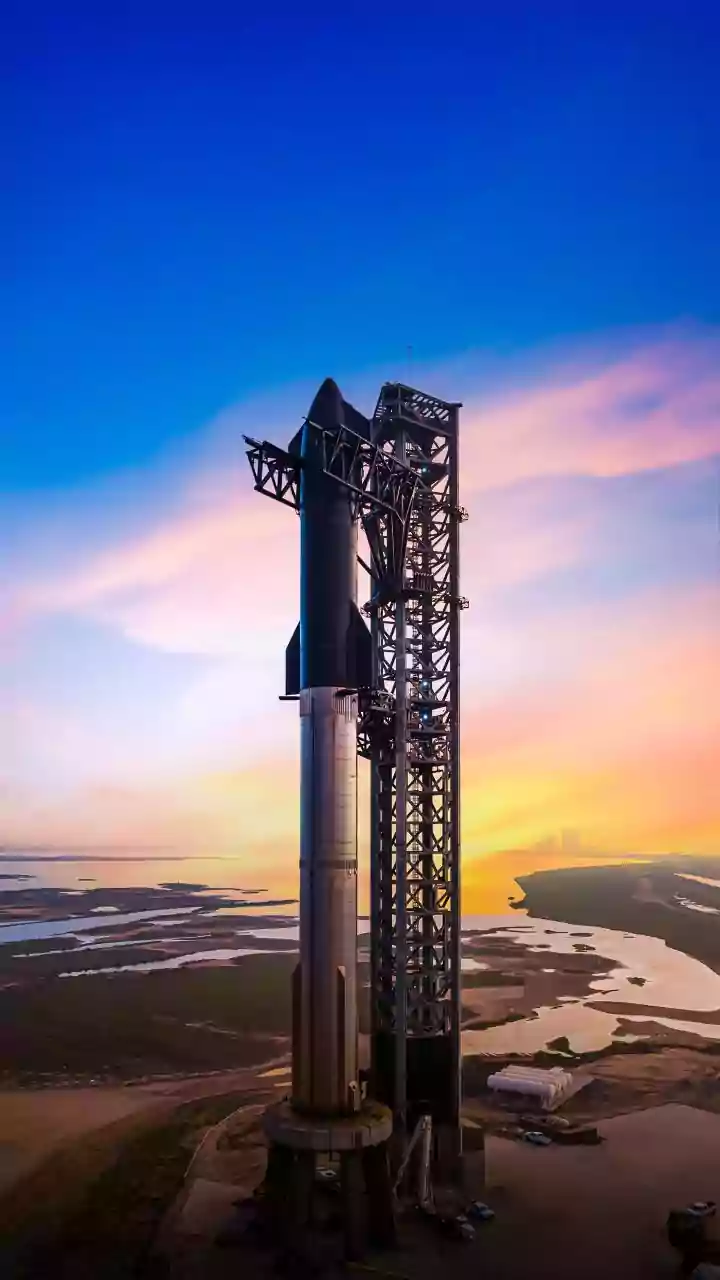
V3: A Towering Ascent
SpaceX is advancing its Starship program with Version 3, a dramatically reconfigured iteration of its colossal rocket. This new design introduces substantial
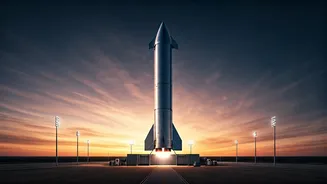
modifications across the Super Heavy booster and the Starship upper stage, as well as its powerful engines. The Super Heavy booster for V3 has grown to an impressive height of approximately 282 feet (86 meters), an increase from the 232 feet (71 meters) of V2. This expansion brings the total height of the integrated launch system to roughly 403 feet (123 meters), dwarfing even the historic Saturn V, which stood at 363 feet (111 meters). This nearly 40-foot increase in height is a significant engineering feat. The booster's base will accommodate an expanded ring of 35 Raptor 3 engines, each generating an estimated 280 metric tons-force of thrust at sea level, an upgrade from the approximately 230 metric tons-force of the Raptor 2. Cumulatively, this results in an expected liftoff thrust exceeding 9,500 metric tons-force, a truly immense power output. The Starship upper stage has also undergone a transformation, gaining additional propellant capacity. This enhancement is projected to boost its payload capability to over 100 metric tons to low-Earth orbit in its fully reusable configuration, with potential to reach over 150 metric tons if used in an expendable mode. While the V2 Ship had a rated capacity of 100 to 150 metric tons to LEO in expendable mode, the V3's advancements in its reusable state represent a more critical engineering breakthrough.
Raptor 3 Propulsion Power
The heart of Starship V3's enhanced performance lies in the Raptor 3 engine, a product of significant internal redesign. External components such as plumbing, heat shielding, and auxiliary hardware, previously visible on the Raptor 2, have been integrated directly into the engine's structure. This consolidation results in a lighter, more streamlined engine with fewer potential points of failure, enhancing reliability and simplifying maintenance. The Raptor 3 operates using a full-flow staged combustion cycle, a sophisticated thermodynamic process. In this cycle, both liquid methane and liquid oxygen propellants undergo partial combustion in separate preburners before being introduced into the main combustion chamber. This method extracts more energy from the propellants compared to traditional gas-generator engine designs. This efficiency is a key reason why Raptor engines achieve chamber pressures exceeding 300 bar, among the highest recorded for operational rocket engines. The elevated chamber pressure directly correlates with increased specific impulse, a critical metric for propellant efficiency. This means that Starship V3 can achieve greater performance and reach higher velocities with the same amount of fuel, a crucial factor for deep-space missions.
Catch System Reusability
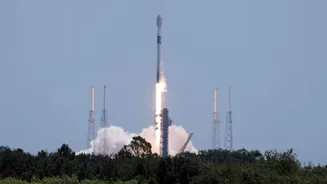
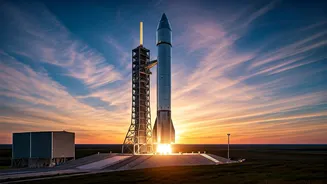
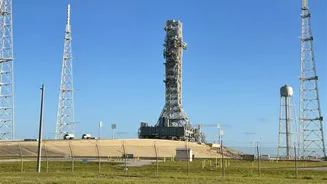
SpaceX's vision for V3 maintains its innovative reusability architecture, centering on the 'Mechazilla' catch system. This system utilizes robotic arms integrated into the launch tower to capture the returning Super Heavy booster, negating the need for traditional landing legs. The company successfully demonstrated this booster catch technology during test flights in late 2024, a crucial step towards operational reliability. For the V3 Starship, the upper stage is also designed to be caught by the same Mechazilla system following its orbital re-entry. The complete catch-and-reuse of both rocket stages is foundational to SpaceX's economic model for spaceflight. Expendable rockets, which discard expensive hardware after each launch, incur costs in the tens or hundreds of millions of dollars per flight. By recovering both stages intact and rapidly reflying them, SpaceX aims to dramatically reduce per-kilogram launch costs, potentially by an order of magnitude compared to conventional launch vehicles. This development is vital not only for commercial satellite deployment but also for NASA's Artemis program, which has contracted a lunar lander variant of Starship, known as the Human Landing System (HLS), to transport astronauts to the lunar surface. Furthermore, other ambitious deep-space exploration initiatives rely on the availability of routine and affordable heavy-lift capabilities.
Challenges Ahead
Despite the impressive advancements, Starship V3 has yet to take flight, and significant engineering hurdles remain. The substantial modifications in propellant tank volume, engine configuration, and overall structural design necessitate extensive integration and certification processes, which inherently consume considerable time. A critical area of ongoing development is the thermal protection system for the Starship's heat shield. This shield must withstand re-entry temperatures exceeding 1,400 degrees Celsius, a challenge that has led to iterative redesigns of its thermal tiles across previous flight tests. Another paramount challenge yet to be demonstrated is orbital refueling, a capability indispensable for any crewed lunar or Martian missions. This maneuver requires Starship to transfer cryogenic propellants between two vehicles while in microgravity. Successfully managing fluid dynamics in a weightless environment presents a complex problem with no easy solutions. SpaceX has identified propellant transfer as a key near-term milestone that must be achieved before crewed lunar missions can proceed. While V3 hardware is reportedly entering production at Starbase in Texas, the first V3 test flight is anticipated within 2025, though SpaceX's history indicates that flight schedules are often adjusted as engineering realities unfold.