





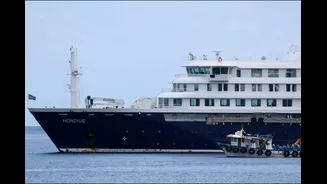

Evacuation Underway
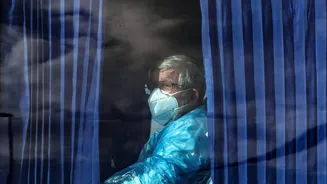
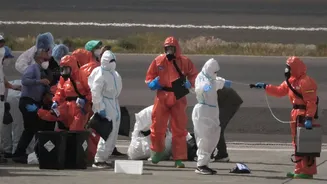
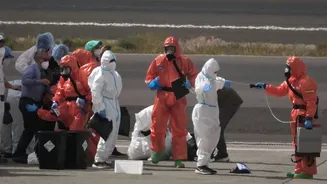
On Sunday, a significant operation commenced to disembark passengers and crew from a cruise ship that had been affected by a hantavirus outbreak. This
complex process, guided by international health authorities, was projected to continue through Monday. The passengers, notably, were not exhibiting any symptoms of the virus at the time of their departure. They were transported via military vehicles to Tenerife airport, where government-arranged planes from their home countries awaited them. Officials stressed that these passengers would have no public interactions. The World Health Organization (WHO) has mandated a 42-day quarantine period for all individuals arriving from the vessel, beginning on Sunday. Early departures included flights for Spanish and French nationals, with Canada, the Netherlands, the UK, Turkey, Ireland, and the United States among the next countries scheduled to repatriate their citizens. A flight for Australian nationals, also transporting passengers from New Zealand and other Asian countries, was anticipated to arrive on Monday.
Virus Detected
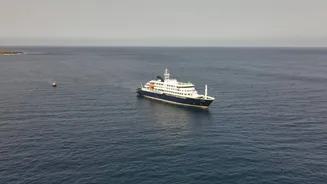
Hantavirus, a disease typically transmitted through rodents but with rare instances of human-to-human spread, was identified on the ship. The first detection occurred on May 2nd, a full 21 days after the initial passenger fatality. South African health officials made the diagnosis while testing a British man who was in intensive care. Since then, two additional former passengers have tragically passed away. The luxury cruise ship had departed from the Cape Verde coast on Wednesday, heading for Spain, following requests from the WHO and the European Union for the country to manage the passenger evacuation after the hantavirus detection. The WHO suggested that the initial infection might have occurred before boarding, possibly during travel in Argentina and Chile, with subsequent transmission likely happening onboard the ship. Notably, no rodents were found on the vessel.
Health Officials Monitor
According to an update from the WHO on Friday, eight individuals who were no longer on the ship had fallen ill, including the three who died – a Dutch couple and a German citizen. Out of these eight, six cases have been officially confirmed as hantavirus. The WHO Director-General, Tedros Adhanom Ghebreyesus, who was present in Tenerife to oversee the evacuation, stated on Sunday that WHO experts were collaborating with Spanish health officials to test the passengers. One Spanish woman, who was under suspicion for the virus after sharing a flight with a deceased patient, received a negative test result late Saturday. In a separate development, the UK military deployed a specialized team via parachute to the remote island of Tristan da Cunha to provide medical assistance to a second suspected case, a British man who was a passenger and resident of the island in the South Atlantic. Currently, four patients remain hospitalized in South Africa, the Netherlands, and Switzerland, while a suspected case sent to Germany tested negative.
Risk Assessment
As a precautionary measure, Europe's public health agency has classified all passengers aboard the MV Hondius as high-risk contacts. This classification was part of their rapid scientific advice issued late Saturday, while simultaneously asserting that the risk to the general population remains low. The Spanish Ministry of Health reported that the ship had passed all necessary health checks. They noted that over 500 cruise ships annually travel from Argentina and Chile, regions endemic to the virus, yet an outbreak of this nature has never occurred on European territory, making its occurrence in relation to this ship highly improbable. The ministry also confirmed the absence of any detected rodents on board. Spanish officials have stated that passengers will not be permitted to leave the vessel until their designated evacuation aircraft has arrived. Thirty crew members are slated to remain on board and will sail the ship to the Netherlands, where it will undergo comprehensive disinfection.