




A Drawing's Impact
A father's shared drawing of him depicted as falling from a roof, yet smiling, sparked widespread online debate and curiosity. While many interpretations
surfaced, ranging from amusement to concern, the incident highlighted a common parental challenge: understanding the true meaning behind a child's artwork. This seemingly simple sketch served as a powerful prompt to reconsider how children express themselves, often blending reality with their inner world in ways that diverge significantly from adult logical interpretations. The reactions underscored the prevalent human tendency to seek direct, literal meanings, especially when dealing with representations of loved ones, yet it also opened a door to appreciating the more nuanced and imaginative communication strategies of young minds. The core question that emerged was not just about deciphering this specific image, but about developing a broader understanding of how children translate their thoughts and feelings onto paper, and how parents can best engage with this unique form of expression.
Beyond Literal Depiction
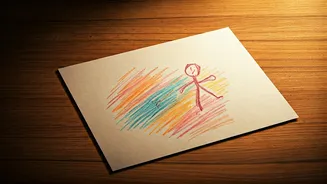
In the viral sketch, a child meticulously illustrated their family on a rooftop. While the figures were drawn with minimal detail, the emotional undertones were striking. The father's representation was shown mid-fall or perhaps a leap, accompanied by a broad smile, starkly contrasting with the somber, still figures of the remaining family members. For adult observers, such an image immediately triggers alarm bells, prompting a frantic search for underlying distress, fear, or anger. However, the critical point is that children's artistic processes do not adhere to linear, adult logic. Their creative output is a vibrant fusion of perceived reality, a rich tapestry of emotions, and boundless fantasy, often in a way that adults may have long forgotten. Therefore, a depiction of falling does not automatically signify peril; it could very well represent movement, transition, or even a sense of exhilarating adventure. The father's smile, in particular, is a vital clue, suggesting the child did not perceive the depicted event as frightening or negative, but perhaps as something dynamic and exciting.
The Art of Interpretation
Drawing for a child is far more than a mere transcription of visual stimuli; it's a complex interplay of their feelings, memories, and imaginative concepts, often coalescing into a single piece. A child might integrate a recent event, such as a parent's departure for work, with a strong emotion like missing that parent or a desire for attention, and then superimpose a fantastical element, perhaps involving themes of flying or heroic actions. Consequently, a falling figure on paper shouldn't be immediately interpreted as a sign of harm. It could be a symbolic representation of departure, a depiction of change, or even an expression of sheer excitement. The child's choice to draw the father smiling is a significant indicator that the moment, as they envisioned it, was not one of fear or distress. This contrasts sharply with adult interpretations, which tend to rely on logical narratives. A parent might see immediate danger, while a child might be conveying simpler ideas: 'Dad leaves sometimes,' 'Dad is engaged in an important activity,' or 'Dad appears distinct from the rest of us in this particular scenario.' Children often amplify scenes to enhance their narrative appeal, transforming a simple roof into a stage and a departure into a dramatic performance. This divergence in understanding arises because adults approach art with logic, whereas children create from the heart.
Understanding Children's Language
A profound, yet often overlooked, truth is that children frequently convey sentiments and ideas they struggle to articulate verbally. An artwork like the one described can serve as a conduit for various underlying feelings or observations: it might highlight a child's awareness of absence or emotional distance, offer a playful exploration of themes like 'leaving' and 'returning,' or provide a safe, creative outlet for processing complex emotions. It's crucial to recognize that not every unusual element in a child's drawing signals a serious issue, but neither should it be dismissed as insignificant. The true value for parents lies in cultivating a stance of gentle curiosity rather than immediate, reactive judgment. Instead of confrontational questions like, 'Why did you draw this?', more open-ended prompts encourage dialogue. Posing questions such as, 'Can you tell me more about what's happening in this picture?', 'How do you think everyone is feeling here?', or 'What happens next in this story?' can create a safe space for children to share their thoughts. Often, the explanations provided by children are surprisingly straightforward. The father's 'fall' might simply represent him 'going somewhere,' and his smile could genuinely signify excitement rather than fear, illustrating the vast difference between adult assumptions and a child's lived experience.
Art as Communication
Before children master the intricacies of verbal expression, drawing serves as their primary mode of communication. These visual creations become invaluable records of their emotional worlds, acting as a safe space for them to experiment with ideas and concepts. Furthermore, art provides a vital pathway for them to connect with their parents, enabling them to share their inner lives without the constraint of perfectly formed language. Incidents like the widely discussed drawing of the father falling remind parents of a fundamental insight: not every peculiar detail in a child's artwork is an immediate red flag or a cause for alarm. Often, these seemingly unusual elements are simply windows into the unique and vastly different ways children perceive and process the world around them, offering parents a precious opportunity to connect more deeply with their child's developing consciousness.