





Pleiades' Spring Farewell
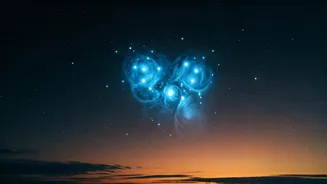
The enchanting Pleiades star cluster, also affectionately known as the Seven Sisters, is currently making its final appearance in our spring night sky.
While it shines brightest between October and March, its position steadily lowers each night after this peak. As April unfolds, this dazzling cluster will increasingly hug the horizon after sunset. Soon, its faint light will be overwhelmed by the sun's glare, rendering it invisible. It won't re-emerge in the evening sky until the tail end of June, when it will be a fleeting guest in the pre-dawn hours, briefly appearing near the ruddy glow of Mars. This transitional period offers a precious, albeit shrinking, window for observers to appreciate its beauty before its seasonal hiatus.
Locating the Stellar Jewel
Discovering the Pleiades is a straightforward endeavor with a little celestial navigation. Begin by locating the prominent constellation of Orion, the Hunter, which graces the southwestern sky in the early evening for much of late March. Once you've identified Orion, focus on its famous belt, comprised of three bright stars. Now, imagine drawing a straight line extending from the star Alnitak (the leftmost star in the belt) through Mintaka (the middle star) and continuing this path outwards. Following this imaginary line will lead you past Aldebaran, a distinct red giant star. Continue a bit further, and you'll soon encounter the faint, hazy luminescence that signals the presence of the Pleiades, a celestial cityscape of distant suns.
Enhancing Your View
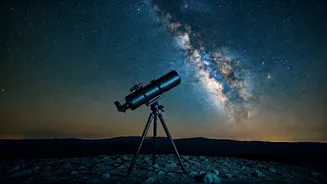
To truly appreciate the Pleiades' stellar tapestry, consider employing some simple optical aids. While the cluster is visible to the naked eye under dark skies, a pair of 10x50 binoculars will significantly enhance your observation. With binoculars, you can clearly discern the seven most prominent stars, often referred to as the Seven Sisters, along with a multitude of fainter, blue-white companions that form the cluster's denser regions. For an even more immersive experience, a small telescope will reveal dozens more stars within this intricate grouping, showcasing its true depth and extent. For those preferring a more casual approach, remember that looking slightly away from the cluster, a technique known as averted vision, can make its faint glow more apparent by engaging the more sensitive parts of your retina.
A Glimpse Through Time
Observing the Pleiades connects you to a long lineage of stargazers, including some of history's most renowned astronomers. For millennia, humans have marveled at this cluster, and its celestial dance has been meticulously documented. In the early 17th century, the pioneering scientist Galileo Galilei was among the first to meticulously record his telescopic observations of the Pleiades. His detailed notes, published in his 1610 work, the Sidereal Messenger, provide an early testament to the cluster's captivating nature and the scientific curiosity it inspired, inviting us to follow in the footsteps of these ancient and modern sky-watchers.