



Witnessing the Alignment
From April 16th to April 23rd, skywatchers in India have a unique opportunity to observe a rare planetary alignment. This celestial gathering involves
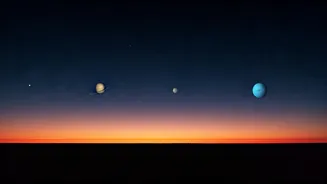
Mercury, Mars, Saturn, and Neptune appearing close together in the morning sky. To catch this phenomenon, early risers are essential, as the best viewing times will be in the hours just before sunrise. Clear skies are a prerequisite, and finding a location with minimal light pollution and unobstructed views towards the east will significantly enhance the experience. The planet positions will evolve throughout the week, making each viewing session potentially different. The most compact formation, ideal for observation, is anticipated between April 18th and April 20th, offering a limited but precious window for this multi-planet spectacle.
Understanding the Phenomenon
A planetary alignment, often called a conjunction, is an optical illusion from our perspective on Earth. It occurs when several planets appear to cluster in the same region of the sky. Crucially, these celestial bodies are not physically close to each other; they remain separated by vast interstellar distances, often millions of kilometers. The illusion of proximity arises because all planets in our solar system orbit the Sun along a roughly similar, flattened plane known as the ecliptic. When viewed from Earth, this shared orbital path can make them seem to line up. This particular event, featuring four distinct planets in close apparent proximity, is relatively uncommon, making it a noteworthy astronomical occurrence for enthusiasts.
What to Look For
During the alignment, the four planets will present themselves at varying heights above the horizon, creating a visual sequence. Mercury, closest to the sun, will likely be positioned low on the horizon and could be obscured by the approaching daylight, making it challenging to spot initially. Its visibility should improve as the week progresses towards April 20th. Saturn will appear higher than Mercury, characterized by a gentle yellowish hue; it is generally visible to the naked eye, though binoculars can offer a clearer view. Mars will be more readily identifiable due to its distinct reddish-orange color, appearing higher in the sky than both Mercury and Saturn. Neptune, the most distant of the four, will be the faintest and will almost certainly require binoculars or a small telescope to be seen.
The Evolving Display
One of the most captivating aspects of this particular planetary parade is the dynamic nature of the planets' arrangement over the observation period. Initially, you might notice the planets forming a configuration that resembles a triangle. However, as the days advance, particularly by April 20th, this pattern will begin to shift, transitioning into a more diagonal line. This gradual change allows observers to witness firsthand the subtle yet significant movements of these celestial bodies against the backdrop of space. Observing this evolution over a short period provides a tangible sense of the planets' orbits and positions relative to one another, adding a layer of scientific wonder to the visual spectacle.