






Rooted in Coorg Tradition
The Kodava community, primarily residing in the Coorg region of Karnataka, is distinguished by its deep-rooted customs and martial heritage. Their wedding
attire elegantly mirrors this inherent strength and grace. In contrast to many other South Indian saree draping styles, the Kodava saree boasts a practical design that facilitates unhindered movement across the undulating terrains of the region. What began as a functional garment has evolved into a symbol of ceremony and prestige, intricately paired with cherished heirloom jewelry. For a Kodava bride, adorning this saree signifies more than just wearing fine silk; it represents the embodiment of her entire ancestral legacy, carried with pride and reverence.
The Distinctive Drape
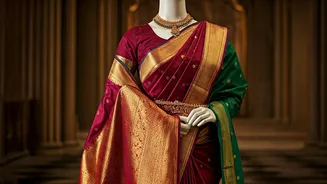
The hallmark of the Kodava wedding saree lies in its unconventional pallu arrangement, a stark departure from the common Nivi style. Instead of the pallu cascading from left to right, it is meticulously pleated at the back and then artfully brought forward over the right shoulder. This unique back-to-front draping technique is not merely an aesthetic choice; it serves as a powerful emblem of identity and tradition. The carefully arranged pleats are then secured at the back with a pin, often embellished with traditional gold brooches, lending the overall look a structured, poised, and distinguished silhouette. This meticulous draping adds a layer of regal elegance that is unmistakably Kodava.
Color Codes and Textiles
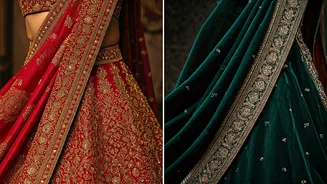
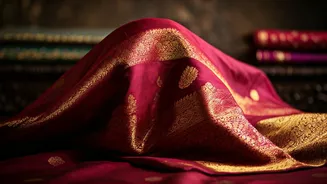
Kodava brides traditionally embrace a palette of rich, auspicious colors, predominantly deep reds, vibrant saffron hues, and classic off-white or ivory shades. These exquisite drapes are typically crafted from pure silk and adorned with opulent gold zari borders. Interestingly, despite their heavy appearance, these sarees are often surprisingly lightweight. The true drama and visual impact of the Kodava wedding ensemble are derived not from excessive embellishments but from the distinctive draping method and the choice of fine textiles. Actress Rashmika Mandanna's recent choice to wear a Kodava-style wedding saree is a significant cultural statement, honoring her heritage and moving away from conventional bridal norms, thereby bringing this beautiful tradition to a wider audience.
Jewelry Symbolism and Continuity
Complementing the unique saree, Kodava bridal jewelry holds profound symbolic meaning and is an integral part of the ensemble. Key pieces include the 'Pathak,' a layered gold necklace, and the 'Jomalae,' a coin necklace signifying prosperity and good fortune. The 'Kokkethathi,' a traditional waist belt, not only cinches the saree beautifully but also provides structural support to the drape. These pieces are not mere adornments; they are heirlooms, often passed down through generations, carrying with them the history and essence of the family. The Kodava bride, adorned in this attire and jewelry, powerfully conveys that a wedding is not solely about the beginning of a new chapter but also about the enduring continuity of the clan, its rich traditions, and its ancestral heritage.