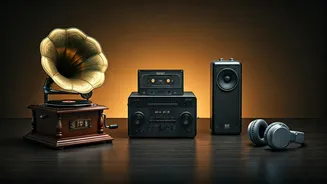









Early Sound Beginnings
In 1878, Thomas Edison's groundbreaking invention, the phonograph, appeared, altering the way people experienced music. This device, utilizing wax cylinders,
offered a revolutionary concept: the capacity to both record and replay sound. This marked the shift from music being confined to live performances, opening doors to an era of recorded sound. The initial format, the wax cylinder, initiated the evolution of recorded music, setting the stage for subsequent innovations in audio technology and shaping the future of how people engaged with music.
Gramophone's Flat Discs
Emile Berliner's innovative Gramophone introduced flat disc records, which soon gained popularity over the cylinders in the early 1900s. These discs empowered individuals to build extensive music collections, contributing to the expansion of music accessibility. As playback devices became stylish home fixtures, music found its way into more households. This transition was a pivotal moment, influencing the music industry by establishing a new standard for music storage and distribution. This early format helped shape the landscape of the music industry.
Vinyl Era Emerges
The period from the 1940s to the 1960s witnessed the ascent of vinyl records, swiftly becoming the dominant format. Vinyl's characteristics, like being lighter and more economical than its shellac predecessors, were key factors in its widespread adoption. Moreover, the emergence of 7-inch singles and 12-inch albums was crucial, expanding music accessibility, especially among youth culture and popular music trends. Vinyl records significantly transformed music culture.
8-Tracks and Convenience
The 1970s brought forth 8-track cartridges, offering an enhanced level of convenience, particularly in automobiles. Even with their shortcomings, 8-tracks played a role in the shift towards on-the-go listening technologies. This format served as a transitional phase, demonstrating a growing inclination towards portable music consumption, paving the way for further advancements in music portability. Although short-lived in the broader scheme, 8-tracks highlighted the growing importance of personal listening experiences.
Cassettes and Portability
Audio cassettes and the Walkman revolutionized how people consumed music in the 1980s. Cassettes greatly boosted music's portability, allowing fans to compile their customized mixtapes. Alongside this, Sony's Walkman revolutionized personal listening by popularizing headphones and portable playback. This development marked a crucial point in the evolution of personal music listening, giving individuals more control over their music choices and when and where they listened.
The CD Revolution
The compact disc (CD) made its mark from the 1980s to the 1990s, boasting a digital sound quality that was marketed as “perfect sound forever”. CDs had a larger capacity than vinyl or cassettes. This affected how artists organized their albums and how fans gathered music throughout the 1990s. The CD format played a key role in the transition from analog to digital music, offering consumers better sound quality and more durability.