
Initial Re-entry Challenges
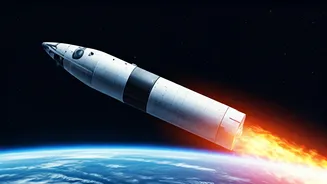
Re-entry is an extremely difficult phase of space travel. Spacecraft, hurtling back to Earth at phenomenal speeds, face extreme heat and intense aerodynamic
forces. Protecting the vehicle and its occupants from these conditions demands meticulous design and innovative materials. Early designs and approaches struggled to withstand these harsh conditions, often leading to significant damage or, in worst-case scenarios, complete mission failure. The problems were many and they needed to be tackled in phases. The early days of spaceflight were marred by the high risks associated with re-entry. This made it essential to develop advanced heat shields, robust structural designs, and sophisticated control systems to provide safe return. SpaceX's mission to enhance the field was always going to be a tough one.
Heat Shield Innovations
One of SpaceX’s most remarkable achievements lies in its pioneering heat shield technology. The heat shield is the first line of defense during re-entry, absorbing the brunt of the extreme heat generated as the spacecraft enters the atmosphere. The company used advanced ablative materials specifically designed to withstand the intense heat. This material works by vaporizing slowly, carrying away heat and protecting the underlying structure. The thermal protection system (TPS) has to withstand temperatures reaching thousands of degrees Celsius. The ability of the material to endure this extreme environment defines the success of re-entry. The use of innovative materials and engineering allows for reliable and efficient atmospheric re-entry, marking a significant step forward in space technology. SpaceX's heat shield advancements were a game-changer.
Aerodynamic Control Systems
Precise control of a spacecraft's descent is essential for safe re-entry. SpaceX engineered sophisticated aerodynamic control systems to manage this complex process. These systems, like advanced flight control software and movable surfaces, allow spacecraft to precisely maneuver. By modifying the angle and attitude of the spacecraft, these controls can manage the forces of the air and guide the vehicle to its landing site. The systems are designed to counteract the extreme aerodynamic forces, providing stability and directional control during descent. SpaceX’s systems enable precise and targeted landing, which minimizes stress and damage to the spacecraft. This precision translates to greater mission success and facilitates the recovery of reusable components. Such measures contributed to the enhancement of the craft and contributed to the safety measures.
Structural Design Enhancements
The structural integrity of a spacecraft is vital during re-entry. SpaceX incorporated innovative designs and materials to enhance their spacecraft's ability to endure extreme forces. The use of lightweight yet robust materials, such as specialized alloys and composites, improved the structural integrity without increasing the overall weight. The advanced design focuses on stress distribution to distribute the forces evenly throughout the spacecraft, thus preventing critical points of failure. SpaceX engineers also devised systems to manage thermal expansion and contraction, which can significantly affect the structural performance during re-entry. These enhancements were critical to ensuring the spacecraft maintained its shape and structural stability during the high-stress environment of re-entry. These measures resulted in a more durable and reliable spacecraft.
Testing and Iteration
SpaceX’s method for perfecting re-entry technology included rigorous testing and relentless iteration. The company conducted extensive simulations, ground tests, and flight tests to identify weaknesses and refine their designs. Each test provided vital information, and the team made adjustments and improvements based on the observed outcomes. They incorporated feedback from previous flights to address specific challenges and enhance the spacecraft’s performance. SpaceX’s continuous improvement cycle facilitated the rapid advancement of their re-entry capabilities. The iterative method allows SpaceX to fine-tune their designs, resulting in increased reliability and safety. This approach allowed them to quickly adapt to problems, eventually leading to a more dependable and effective solution to re-entry challenges. Iterative improvements were key.
Reusable Spacecraft Strategy
A core goal of SpaceX’s re-entry innovations is the ability to reuse spacecraft components, specifically the first stage boosters and the spacecraft themselves. The capacity to reuse these expensive elements dramatically reduces the overall cost of space travel and makes missions much more affordable. SpaceX developed advanced landing techniques and systems to enable the boosters to safely land back on Earth. Their successful landing and recovery of rockets revolutionized spaceflight economics. The ability to reuse boosters requires robust heat shields, precise aerodynamic control, and durable structural designs, all of which SpaceX has successfully implemented. The reusable spacecraft strategy is a cornerstone of SpaceX’s operations, contributing to its vision of making space accessible.
Starship V2 & V1
SpaceX is continually improving its Starship design, with the evolution from V1 to V2 reflecting the ongoing engineering. Although V2 has since been retired, it played a pivotal role in the development and refinement of the technology needed. V2, in its service, helped to test the latest advances in materials, thermal protection, and control systems. The insights gained from the V2 program fed directly into the development of future iterations of the spacecraft. SpaceX uses the learnings from each version to advance its reusable spacecraft capabilities. The work on V2 has helped SpaceX build on the knowledge base that it had from the original Starship design. The improvements are constant and based on past models.
Future Developments
SpaceX continues to invest in the research and development of re-entry technologies. Their future work includes refining thermal protection systems to endure even higher temperatures and stresses. The company is actively exploring new materials and designs. The integration of advanced autonomous control systems to further improve the precision and reliability of landings is a major objective. SpaceX is also focusing on improving the reusability of spacecraft components. By pushing the boundaries of re-entry technology, SpaceX is preparing to venture into deeper space. Their plans are paving the way for more ambitious missions and revolutionizing space travel.