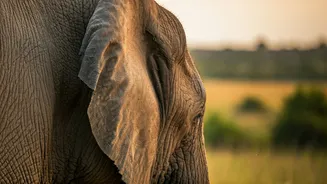








Elephantine Echoes
African elephants possess an astonishing ability to communicate over vast distances using low-frequency rumbles, known as infrasound. These powerful, deep
vibrations travel through both the earth and the air, enabling entire herds to maintain contact and alert each other to potential dangers even when miles apart. This sophisticated system of auditory signals allows them to coordinate movements, share information about food sources, and ensure the safety of the group, showcasing a profound level of social cohesion and environmental awareness. Their ability to perceive and utilize these subtle vibrations highlights a communication network far beyond human hearing.
Indri's Rainforest Songs
Among the rarest of lemurs, the indri enchants with its melodious vocalizations that resonate through the dense Malagasy rainforests. These aren't mere calls; they are complex songs, often performed in synchronized choruses by family groups. This communal singing serves multiple vital purposes: it reinforces the strong social bonds within their units, clearly demarcates their territories from rivals, and may even play a role in attracting mates. The haunting beauty of their songs is a testament to their intricate social structure and their deep connection to their environment.
Kakapo's Nightly Booms
The critically endangered kakapo, a unique nocturnal parrot, employs a distinctive method to find mates during the breeding season. Males produce deep, resonant booming sounds that can carry significant distances through the forest under the cover of darkness. This auditory beacon is crucial for females, allowing them to pinpoint potential partners in their vast arboreal habitat. The effectiveness of these booming calls in overcoming the challenges of the dense environment underscores the specialized adaptations these birds have developed for reproduction and survival.
Narwhal's Arctic Clicks
Often referred to as the 'unicorn of the sea' due to its prominent tusk, the narwhal navigates and communicates within the frigid Arctic waters using a rich repertoire of sounds. They produce a variety of clicks, whistles, and pulsed emissions, forming a complex auditory language. This sophisticated communication system is essential for their survival, aiding in navigation through the often-opaque icy seas, locating essential food sources, and maintaining cohesion within their social groups, or pods, as they travel and hunt together.
Prairie Dog Dialects
Prairie dogs are renowned for possessing one of the most intricate 'languages' found in the animal kingdom. Their alarm calls are remarkably detailed, capable of conveying specific information about approaching predators. Astonishingly, these calls can differentiate between threats such as a hawk versus a human, and can even communicate the predator's size, speed, and the direction from which it is approaching. This nuanced communication system allows their colonies to mount appropriate defensive responses, demonstrating a high degree of observational acuity and cooperative defense.
Sifaka's Mixed Signals
Sifakas, a particular type of lemur exclusively found on the island of Madagascar, communicate through a multi-faceted approach. They utilize a combination of vocalizations, olfactory cues through scent marking, and expressive body language to convey their intentions and social status. These varied signals are instrumental in coordinating their movements as they leap through the forest canopy, reinforcing their family ties, and maintaining the intricate social dynamics of their groups. Their reliance on a diverse array of communication methods highlights their adaptability and complex social lives.