




Supersonic Rotor Breakthrough
NASA has achieved a monumental feat by successfully testing new rotor systems designed for Mars helicopters, pushing them to speeds previously thought
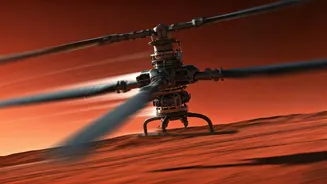
unattainable. During rigorous trials conducted in simulated Martian conditions at NASA’s Jet Propulsion Laboratory, two distinct rotor configurations – one with two blades and another with three – demonstrated astonishing performance. These systems reached rotor tip speeds of up to Mach 0.98, and with the addition of extra headwinds, they actually broke the Martian sound barrier, hitting Mach 1.08. The rotors spun at an impressive 3,750 revolutions per minute, a rate approximately ten times faster than what is found on many helicopters operating on Earth today. This remarkable achievement is a critical step towards enabling more advanced aerial exploration on Mars, paving the way for future missions with enhanced capabilities.
Thriving in Thin Air
The necessity for these extreme rotor speeds stems directly from the unique environment of Mars. The Red Planet boasts an atmosphere that is exceedingly thin, measuring only about 1% of Earth’s atmospheric density. This sparse atmosphere presents a significant challenge for generating sufficient lift for flight. Compounding this issue, the speed of sound on Mars is considerably lower than on Earth, standing at roughly 537 mph (864 km/h), compared to Earth’s sea-level speed of approximately 767 mph (1,235 km/h). These high-speed rotors, a product of a collaboration between NASA and AeroVironment under the Project SkyFall initiative, are engineered precisely to overcome these atmospheric hurdles, making powered flight in such a tenuous environment a reality and not just a theoretical possibility.
Project SkyFall's Vision
Project SkyFall represents a bold vision for the future of Mars exploration, aiming to deploy a fleet of advanced rotorcraft for comprehensive reconnaissance. This ambitious mission, provisionally slated for a December 2028 launch, intends to transport three state-of-the-art Mars helicopters aboard a single spacecraft to the Red Planet. Upon successful landing, these helicopters would be deployed to diverse regions, undertaking independent exploratory missions. The spacecraft itself would serve as a vital hub for communication and operational control, ensuring seamless coordination and data relay. This initiative marks a significant evolution in Mars exploration strategy, moving beyond single-craft missions to a coordinated aerial network, further enhancing our ability to map and understand the Martian landscape.
Building on Ingenuity's Legacy
The upcoming Project SkyFall helicopters will build upon the groundbreaking success of NASA's pioneering Ingenuity Mars Helicopter mission from 2021. Ingenuity, a small rotorcraft with carbon-fiber blades, demonstrated the feasibility of powered flight on Mars, reaching areas that terrestrial rovers like Perseverance could not easily access. Initially planned for just five flights, Ingenuity vastly exceeded expectations, completing an impressive 72 flights and covering a remarkable distance of approximately 2,300 feet (704 meters) in its longest excursion. This historic mission provided invaluable data and proved the concept of aerial exploration on Mars, laying the essential groundwork for the development of these new, ultra-fast rotor systems and proving that flight in such a challenging environment is achievable.
Overcoming Martian Hurdles
While Ingenuity proved flight is possible, the challenges of exploring Mars from the air remain substantial. The planet’s thin atmosphere necessitates incredibly high rotor speeds for lift, a feat Ingenuity achieved with rotor tip speeds around Mach 0.7. However, Ingenuity was a very small vehicle, weighing just 1.8 kg (4 lbs) and lacking any payload capacity, meaning it carried no scientific or communication equipment. Scaling up presents new difficulties: larger aircraft create more drag and require significantly more thrust. The newly tested supersonic rotors offer a potential solution, generating the necessary thrust at near-supersonic speeds, while advanced engineering is addressing the risk of structural failure under such extreme forces, a problem that has historically limited rotorcraft design.
Future Capabilities Unlocked
The successful validation of these supersonic rotor systems marks a pivotal advancement, promising to revolutionize the design and capabilities of future Mars exploration vehicles. NASA aerodynamicist Shannah Withrow-Maser highlighted the significance of reaching Mach 1.08, exceeding initial expectations and suggesting even greater potential thrust is still being analyzed. These next-generation helicopters, empowered by this technology, will be substantially larger, enabling them to carry more robust batteries for extended missions, sophisticated scientific instruments for deeper analysis, and improved communication systems for more efficient data transfer. Ultimately, Project SkyFall's helicopters are poised to conduct low-altitude aerial reconnaissance, gather crucial scientific data, and pave the way for both future robotic and human expeditions to the Red Planet.