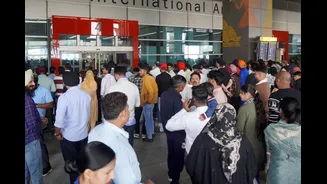









Widespread Travel Chaos
A significant wave of disruptions swept through Asian airports, impacting air travel for countless passengers. This widespread chaos resulted in at least
67 flight cancellations and close to 1,470 delayed services across numerous countries, including India, Thailand, Japan, Singapore, Indonesia, and the United Arab Emirates. The cascading effect led to extended queues, missed connections, and severely overcrowded airport terminals, turning what began as isolated delays into a region-wide crisis. Aviation data from April 12th underscored the severity, with nearly 445 cancellations and over 3,800 delays recorded across Asia and the Gulf region, affecting both domestic and international travel routes between distant locations like Japan and China to Saudi Arabia and the UAE. This extensive disruption significantly hampered travel plans for a vast number of people.
Major Hubs Under Strain
Key international aviation hubs found themselves overwhelmed, struggling to manage the influx of passengers and operational demands. Cities such as Jakarta, Tokyo, Beijing, Jeddah, and Dubai became focal points of congestion as airlines grappled with aircraft scheduling and ensuring sufficient crew availability. Passengers undertaking journeys between Asia, the Middle East, and Europe experienced prolonged layovers, unexpected rerouting of their flights, and even overnight disruptions, significantly impacting their travel timelines. Specifically, Soekarno-Hatta International Airport in Jakarta reported a substantial number of issues with 216 delays and 13 cancellations. Bangkok's Suvarnabhumi Airport also faced considerable strain, recording 199 delays. In Japan, Tokyo's airports were heavily affected; Haneda Airport saw 182 delays, while Narita recorded 90 delays and 10 cancellations. Indian airports also experienced significant disruptions, with Delhi's Indira Gandhi International Airport logging 176 delays, and Mumbai and Bengaluru witnessing substantial delays due to intense domestic travel.
Airline Operational Issues
A variety of airlines across the Asian region reported facing considerable operational setbacks, contributing to the widespread flight disruptions. Carriers like China Eastern Airlines, Batik Air, SpiceJet, and ANA Wings were among those most severely impacted by these challenges. Further analysis from travel media indicated that Batik Air and United Airlines each recorded the highest number of cancellations, with 10 each. Within India, domestic carriers experienced a notable surge in delayed flights; IndiGo reported 93 delayed flights, while Air India logged 74 delays alongside 4 cancellations. All Nippon Airways also reported 75 delays, a significant portion of which were attributed to congestion issues specifically within Tokyo's airspace and airport facilities. Even major global airlines such as Emirates, Singapore Airlines, Thai Airways, and Lion Air were not immune, as the network-wide ripple effects of these disruptions extended across their diverse routes and flight schedules.
Factors Driving Disruption
The current crisis in Asian air travel appears to stem from a confluence of interconnected issues that have placed immense pressure on airline operations and airport infrastructure. A primary driver is the sheer volume of passenger traffic, coupled with operational bottlenecks that have emerged at major hub airports, exacerbating existing logistical challenges. Furthermore, external factors such as geopolitical tensions, limitations imposed by airspace restrictions, and the escalating costs of aviation fuel have collectively made it increasingly arduous for airlines to maintain their scheduled operations smoothly. Airports that handle a high density of domestic and regional traffic, particularly in countries like Indonesia, Thailand, Japan, and India, have proven to be the most susceptible to these cascading disruptions. Key metropolitan areas, including Delhi, Tokyo, Dubai, Jakarta, Bangkok, Mumbai, Bengaluru, and Singapore, have all experienced severe operational strain due to these combined pressures, with Jakarta and Bangkok recording the highest number of delays and Tokyo and Delhi facing significant issues due to heavy passenger volumes.
Navigating Travel Uncertainty
Given the likelihood of continued delays and cancellations in the immediate future, travelers are strongly advised to adopt a proactive approach to manage their journeys. It is crucial to stay informed by regularly checking real-time flight updates through airline applications and official airport websites. Maintaining communication with your airline for any potential rescheduling or information regarding compensation is also recommended. To mitigate last-minute stress, passengers should plan to arrive at the airport well in advance of their scheduled departure time. Ensuring all essential travel documents are readily accessible will streamline the process at various checkpoints. Furthermore, paying close attention to airport announcements for any changes in gate assignments or flight timings can prevent confusion and missed opportunities. While flight operations may gradually stabilize, the combination of robust travel demand and persistent operational hurdles suggests that disruptions could persist for some time, making preparedness essential for navigating this period of uncertainty.