
Rocket's Grand Arrival
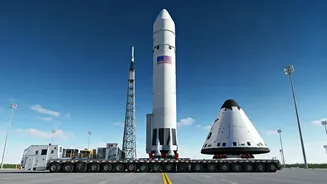
On January 17, NASA transported the Artemis 2 rocket to the launch pad, marking a pivotal moment in the lead-up to the mission. The event involved the massive
Space Launch System (SLS) rocket and the Orion capsule, which will carry astronauts on a journey around the Moon. This rollout is a key part of the preparations for the mission, which is targeted for launch next month, potentially in 2026. The sight of the assembled rocket and capsule at the launch pad signaled the operational readiness of the system, a complex undertaking of coordination and logistical efforts. The rollout was not merely a physical movement, but a demonstration of progress, and was accompanied by intense anticipation from scientists, engineers, and space enthusiasts worldwide. This is a monumental step forward in NASA's long-term plan to return humans to the Moon, and ultimately, to Mars.
Mission's Main Goal
The primary goal of the Artemis 2 mission is to send astronauts on a flight around the Moon, and this will be a crucial test of the systems that will eventually take humans to the lunar surface. The Orion capsule will carry a crew of astronauts on a lunar flyby, demonstrating the spacecraft's ability to support human life in deep space. Engineers will evaluate the performance of the SLS rocket, Orion spacecraft, and ground systems throughout the mission. A successful Artemis 2 flight will establish the foundation for Artemis 3, the mission that will put humans back on the Moon. This mission serves as a critical demonstration of NASA's commitment to returning humans to the Moon in the next few years. The mission's success relies on complex coordination, advanced technology, and rigorous testing.
Early Astronauts Return
Coinciding with the Artemis 2 preparations, a medical evacuation from the International Space Station (ISS) was conducted for the first time. Crew-11 astronauts safely returned to Earth on January 14, marking a significant, unprecedented event in space medicine. The astronauts were brought home early due to a medical situation that required them to return to Earth for treatment. This event underscored the importance of medical capabilities in space missions, especially as astronauts venture farther into space. NASA's swift action demonstrated its capability to protect astronauts' health and well-being. This early return was an example of how safety remains the top priority for space missions, and it highlights the advanced medical support available to astronauts.
Launch Date Timeline
While NASA aimed to launch Artemis 2 next month, the exact date was uncertain, given the complexity of operations and the possibility of further delays. This uncertainty highlights that NASA prioritized safety and thoroughness over speed, in order to make the mission as safe as possible. The team was taking its time and making sure that all systems are operational before approving the launch. The mission involves the integration of numerous components, including the SLS rocket, the Orion capsule, ground systems, and launch facilities. The integration of all of these parts takes a considerable amount of time. All these factors would determine the eventual launch date, making the entire operation more complex, but ultimately, safe for the astronauts.
ISS Evacuation Impact
The early return of the Crew-11 astronauts from the ISS was not expected to interfere with the Artemis 2 moon mission launch. The ISS evacuation demonstrated NASA's ability to handle unexpected events while maintaining its primary goals. The incident did not shift the timeline for the Artemis 2 mission. NASA continued to work to ensure the success of the Artemis 2 mission. NASA officials stated that the evacuation was a testament to the safety protocols and collaborative efforts in space operations, and that both the ISS and Artemis programs continued to function. NASA was prepared to manage both the medical evacuation and the preparations for the Artemis 2 mission concurrently.
Budget and Future
NASA received a $24.4 billion budget approved by Congress. This budget will support the agency's upcoming projects, including the Artemis program, and various other space exploration initiatives. While funding played a key role in NASA's plans, it also faced challenges, as it sought to cut costs while maintaining operational safety. The budget approval by Congress showed a commitment to future space missions and programs, and the funds would assist NASA in the Artemis missions, which will send humans back to the Moon. In addition, the money would support other projects like ongoing research, technology development, and exploration missions. This long-term commitment will help NASA remain a leader in the space sector and drive exploration efforts for the coming years.