







The Botanical Berry Blueprint
From a scientific perspective, classifying fruits isn't about taste or appearance, but rather how they originate from a plant's flower. The core of botanical
fruit classification lies in their reproductive structures. A true berry, in botany, is a specific type of fruit that develops from a single ovary within a flower. Crucially, these fruits typically contain multiple seeds embedded within a fleshy interior. This precise definition means that many fruits we commonly eat, like grapes and tomatoes, also qualify as true berries. The structure originating from a single flower's ovary, yielding a fleshy fruit with numerous seeds, is the defining characteristic that scientists use. This scientific approach often leads to classifications that diverge significantly from our everyday understanding of fruits based on their common culinary uses and sensory attributes.
Bananas: The Unexpected Berry
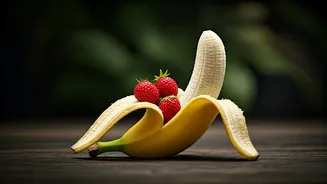
The humble banana fits the botanical definition of a berry remarkably well. It originates from a single flower's ovary, and its internal structure consists of a soft, fleshy pulp surrounding what were historically seeds. Modern commercially grown bananas are often seedless due to selective breeding and cultivation methods, a phenomenon known as parthenocarpy, where fruits develop without fertilization. However, this absence of visible seeds doesn't disqualify them from being berries. Their genetic and developmental origins, stemming from a single ovary of a flower and possessing a characteristic fleshy interior, firmly place them in the berry category according to botanical science. Therefore, despite the common perception, a banana's true botanical identity is that of a berry.
Strawberries: An Aggregate Anomaly
Despite their name, strawberries do not meet the botanical criteria for a true berry. Instead, they are classified as aggregate fruits. This classification arises because a strawberry develops from a flower that possesses not one, but multiple ovaries. Each of the tiny specks that we commonly refer to as 'seeds' on the exterior of a strawberry is, in fact, an individual fruit in itself, known botanically as an achene. These achenes contain the actual seeds of the plant. The fundamental difference lies in the origin: true berries stem from a single ovary, whereas strawberries originate from a flower with many ovaries, leading to their distinct structure and botanical classification as aggregate fruits, not true berries.
The Crucial Ovarian Distinction
The fundamental differentiator between a botanical berry and other fruit types, such as the strawberry, lies solely in the number of ovaries involved in their development from a flower. A banana, originating from a single ovary, aligns with the definition of a berry. Conversely, a strawberry, developing from a flower with multiple ovaries, is categorized as an aggregate fruit. This distinction might seem counterintuitive when compared to our everyday experiences with fruits, but it is rooted in the precise reproductive mechanisms of plants. Understanding this botanical rule highlights the fascinating intricacies of plant biology and challenges our conventional understanding of what constitutes a berry, demonstrating that scientific classification prioritizes developmental origin over common culinary perception.