



Next-Gen Thruster Tested
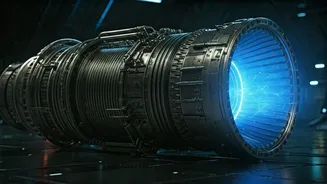
NASA recently conducted a significant test of an advanced ion engine prototype, a critical technology aimed at revolutionizing deep-space exploration.
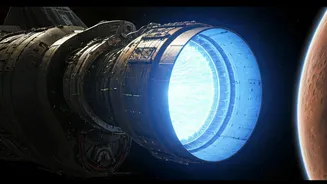
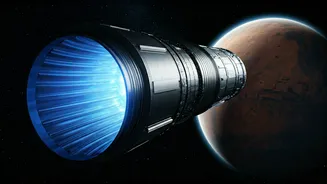
This new engine, referred to as SR-1 (Space Reactor-1 Freedom) in conjunction with NASA's nuclear spacecraft concept, represents a monumental leap in propulsion capabilities. It's designed to be substantially more potent, reportedly offering a propulsion force 25 times greater than current electric propulsion systems in use. Unlike conventional rocket engines that expend fuel rapidly, this innovative thruster is engineered for sustained operation, enabling continuous acceleration for extended journeys across the cosmos and ultimately, facilitating quicker crewed missions to Mars. This development signifies a major stride towards making ambitious interplanetary travel more feasible and efficient.
Lithium-Fed Propulsion Explained
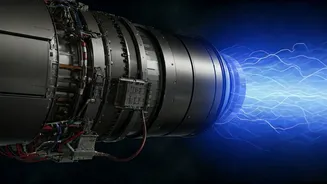
The newly tested prototype, a lithium-fed magnetoplasmadynamic thruster, operates on principles distinct from traditional chemical rockets that rely on explosive combustion. Instead, this advanced engine harnesses electricity and magnetic fields to accelerate charged lithium particles, expelling them at high velocity to generate thrust. This process results in a steady, persistent push, rather than the instantaneous burst of acceleration typical of conventional rockets. Imagine the difference between flooring a powerful gasoline car for a brief moment and a highly efficient electric vehicle that continuously accelerates. This continuous thrust, though not immediately explosive, builds speed over time, allowing spacecraft to achieve remarkable velocities for prolonged periods, ideal for the vast distances of space.
Ion Engines: Efficiency Gains
The strategic focus on ion engines stems from their remarkable efficiency compared to traditional rocket technology. While chemical rockets provide immense initial thrust, they consume vast amounts of fuel in a short duration. Ion engines, conversely, exhibit slower initial acceleration but demonstrate exceptional fuel economy, utilizing approximately 90% less propellant. This drastic reduction in propellant mass allows spacecraft to be lighter, thereby enabling them to travel farther and more efficiently. NASA has a history of successfully employing ion propulsion in missions such as Deep Space 1, Dawn, DART, and Psyche. However, this latest prototype operates on an entirely different magnitude of power. During testing at the NASA Jet Propulsion Laboratory, the prototype achieved 120 kilowatts, a figure significantly higher than the power output of the engine on the Psyche spacecraft. Researchers are aiming to further scale this technology, with ambitions to reach 500 kilowatts, 1 megawatt, and eventually 4 megawatts, a power range suitable for propelling crewed spacecraft to Mars.
Powering Deep Space Travel
A primary challenge for ion engines has traditionally been their power source. Most current systems depend on solar panels, which are effective when operating in proximity to Earth where sunlight is abundant. However, as spacecraft venture further into deep space, the diminishing intensity of solar radiation renders solar panels less practical. This is where NASA's SR-1 project becomes particularly relevant. The concept behind SR-1 involves utilizing a compact nuclear reactor to generate a continuous supply of electricity in space, effectively creating an "always-on battery" to power advanced propulsion systems. The newly developed lithium-fed ion engine is poised to be a key technology integrated with such a reactor system. The synergy between a nuclear reactor providing consistent energy and ion engines utilizing that energy for sustained thrust promises to dramatically shorten travel times for missions to Mars, making them considerably more achievable.
The Propulsion Race
While the successful testing of an ion engine in a vacuum chamber might not garner the same public attention as a rocket launch, it represents a pivotal advancement in space exploration. Major spacefaring nations, including the United States and China, are actively pursuing ambitious goals such as establishing lunar bases, developing deep-space infrastructure, and undertaking Mars missions, often envisioning nuclear-powered spacecraft. Propulsion technology stands as one of the most significant technological hurdles in achieving these objectives. Breakthroughs in this area have the potential to redefine entire epochs of space exploration. Consequently, the nation that first masters fast and efficient long-distance space travel will possess a substantial strategic advantage in the ongoing global race for space dominance and exploration.