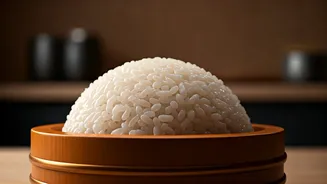






The Heart of Sushi
The journey of sushi begins with its name, derived from 'su-meshi,' signifying 'vinegared rice.' This etymology underscores a profound culinary truth:
sushi's essence lies not in the fish, but in the meticulously prepared rice. Historically, sushi evolved from 'narezushi,' an ancient method of preserving fish through rice fermentation. Over centuries, the process transformed, leading to 'hayazushi' in the 1600s, where vinegared rice and fresh fish were consumed together. Modern Japanese chefs refer to this foundational element as 'shari,' 'sushi-meshi,' or 'su-meshi.' In Japan's finest sushi establishments, the rice is a point of intense pride, with some chefs dedicating years to perfecting its preparation before ever considering the seafood. This emphasis highlights that while fish quality is essential, it's the rice that truly distinguishes a master sushi chef.
Why Homemade Shines
Embarking on homemade sushi rice preparation offers distinct advantages over relying on restaurant offerings. Economically, a bag of sushi rice, typically costing between ₹200-300, yields enough for 20-30 rolls, a stark contrast to the ₹800-1,200 charged per roll in many eateries. Furthermore, making sushi at home ensures unparalleled freshness; you control the exact moment the rice is prepared, avoiding the potential bulk preparation and extended use that can occur in busy restaurants. This direct control extends to flavour customization – you can fine-tune the balance of vinegar, sugar, and salt to perfectly suit your palate, whether you prefer a tangier or sweeter profile. It also guarantees the use of high-quality ingredients like pure rice vinegar and real sugar, free from artificial additives. Ultimately, home cooks often achieve superior rice quality compared to average restaurants because they invest more personal care and attention into each specific batch.
Authentic Sushi Rice Recipe
Prepare to create exceptional sushi rice at home with this comprehensive recipe, yielding enough for 4-5 sushi rolls and serving 4-6 people in approximately 40 minutes (10 minutes prep, 20 minutes cooking, 10 minutes cooling). For the rice itself, you will need 2 cups of Japanese short-grain rice, often labelled 'sushi rice' from brands like Nishiki, Koshihikari, or Calrose, combined with an exact 1:1 ratio of 2 cups of water. Optionally, a small 5x5 cm piece of kombu (kelp) can be added for an extra layer of umami. The sushi vinegar (sushi-zu) requires 4 tablespoons of unseasoned rice vinegar (this is vital), 2 tablespoons of sugar, and 1 teaspoon of salt. Essential equipment includes a rice cooker or heavy-bottomed pot with a lid, a large mixing bowl (a traditional wooden hangiri is ideal but not essential), a wooden or plastic spatula to avoid damaging the grains, a small saucepan for the vinegar mixture, and optionally, a fan for cooling, along with a damp cloth or paper towel.